close

News
Date published:
April 3, 2026
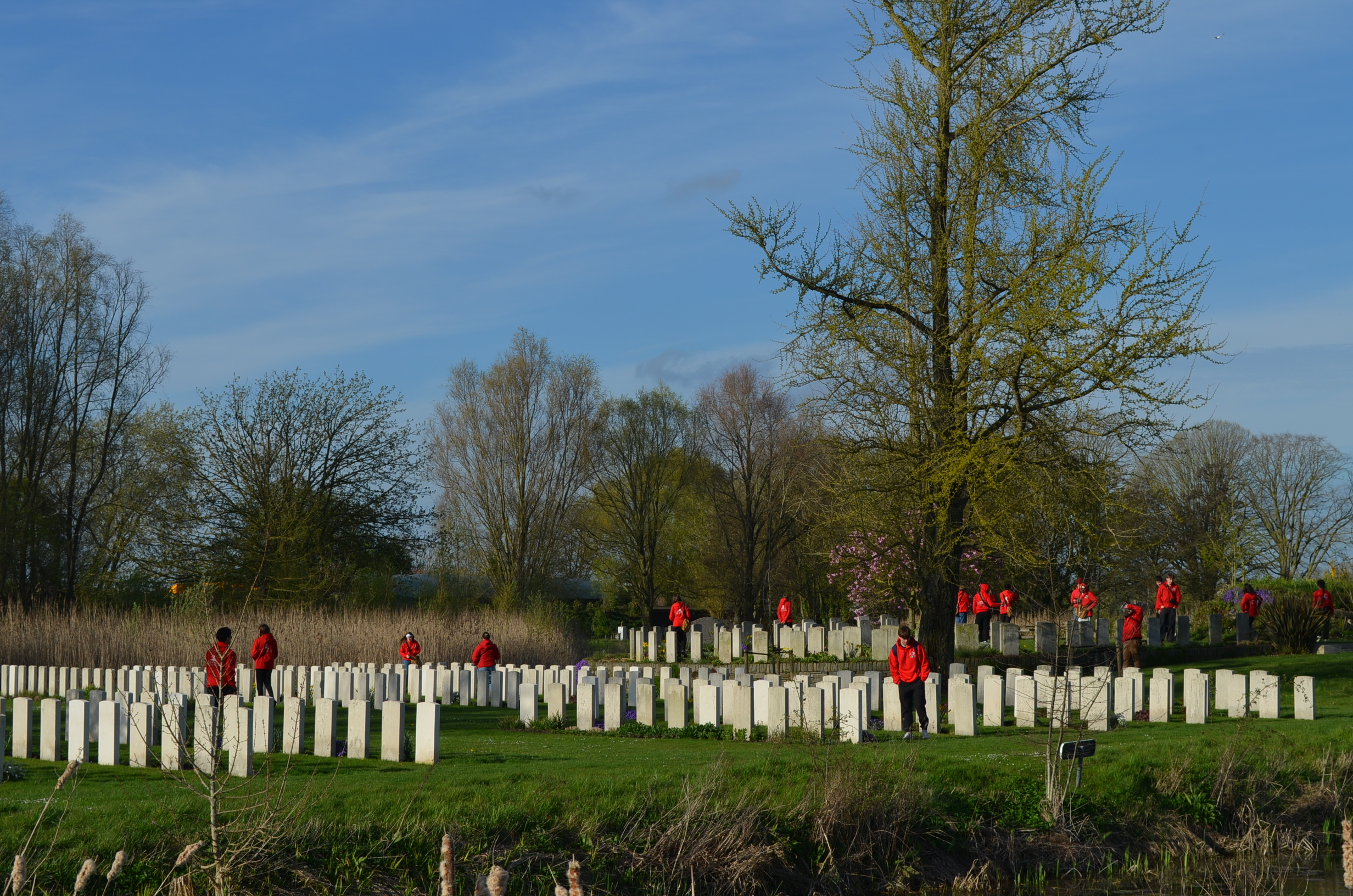
Today the 2026 Vimy Pilgrimage Award recipients arrived in Belgium beginning their 8 day journey across Europe where they will spend time visiting cemeteries, museums, battlefields and commemorative sites from the First World War. Today some of the students shared what site they were most looking forward to visiting, or what topic they are looking forward to learning about.
Jasmine: A topic I’m interested in learning about is hour minority groups (like me); Chinese/Black/Indigenous, were treated and how they contributed during the First World War. As someone who identifies as part of a minority group, learning about this theme could educate me of their experience and how perspectives/societies have changed since then.
Connor: A site which I am particularly looking forward to exploring is the Beaumont-Hamel Memorial, for its significance in relation to the Royal Newfoundland Regiment’s war efforts and casualties. Furthermore, the fact that relatives of mine are commemorated on the monument will make for a very personal experience for me.
Ella B: I’m looking forward to learning more about the roles of women in the war effort. This is an often ignored topic in most discussions surrounding the First World War, so I’m really excited to be able to delve into it and a better understanding of women’s contributions during times of conflict.
Abhiraj: In all the sites I believe we are visiting, I am most excited to see the Menin Gate as the Last Post Ceremony is an event that happens every night and I am expecting this to be a magical experience for me. I would also love to visit the British Grenadier Bookshop near the gate as I heard it was closing and I would love to support their store.
Joseph: I am most looking forward to visiting the Passchendaele sites. It was the battle in which my great-grandfather fought in and I am very much anticipating being there in person.
Ella C: It is the largest memorial for Newfoundlanders and Labradoreans who fought in the First World War and therefore I am most excited to visit and have no known graves. As a Newfoundlander myself, I want to deepen my understanding of my province’s past and I feel physically being present there will allow me to create a connection with those before me.
Jessy: I am very eager to learn more about Indigenous involvement in First World War. My interest began when I learned about Francis Pegahmagabow, Alex Decouteau, and the Timber Wolf Battalion – and I am hoping to gain more knowledge to futher my understanding of Indigenous contributions in the First World War.
Cynthia: I’m most looking forward to visiting the St-Julien Memorial to learn about the Second Battle of Ypres and the use of chlorine gas. Also, I am interested in visiting the Passchendaele Museum because it was such an impactful event for Canadian soldiers and the mass casualties that followed.
Paul: I think I am most excited to visit Passchendaele since that is where the actions of the solider I chose earned him his Victoria Cross.
Mia: The theme I am most excited to explore is the “daily lives of soldiers” as it was one of my choices and a topic I am very much interested in. It feels important to me to learn more by doing research, having discussions, and visiting sites in-person that will allow me to better visualize what it would be like in their shoes.
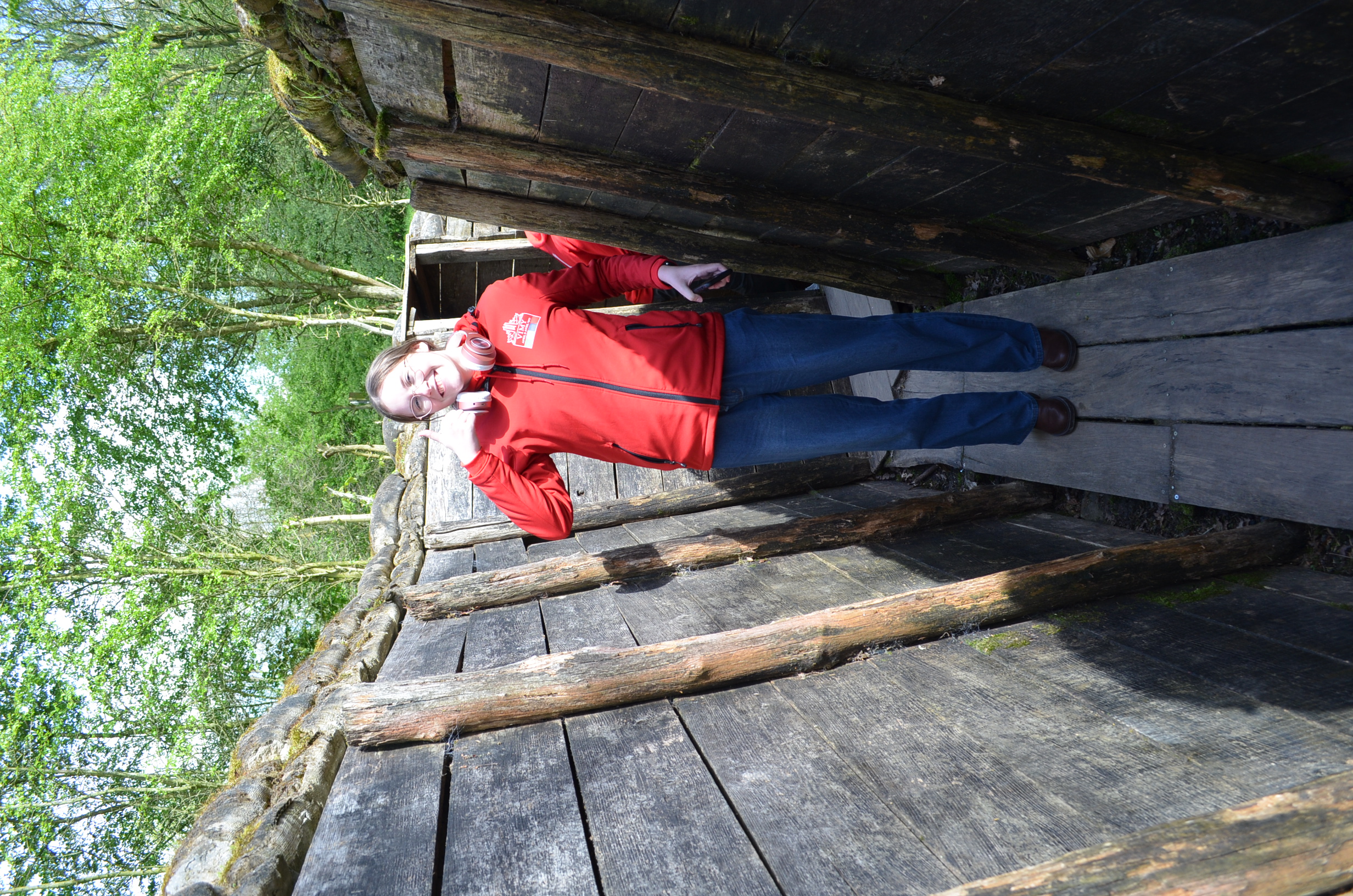
While visiting the Bedford House Cemetery, Emily found the grave of one of her family members who served and was killed in action at just 21 years old. Emily shared her thoughts on the day.
Emily Munro
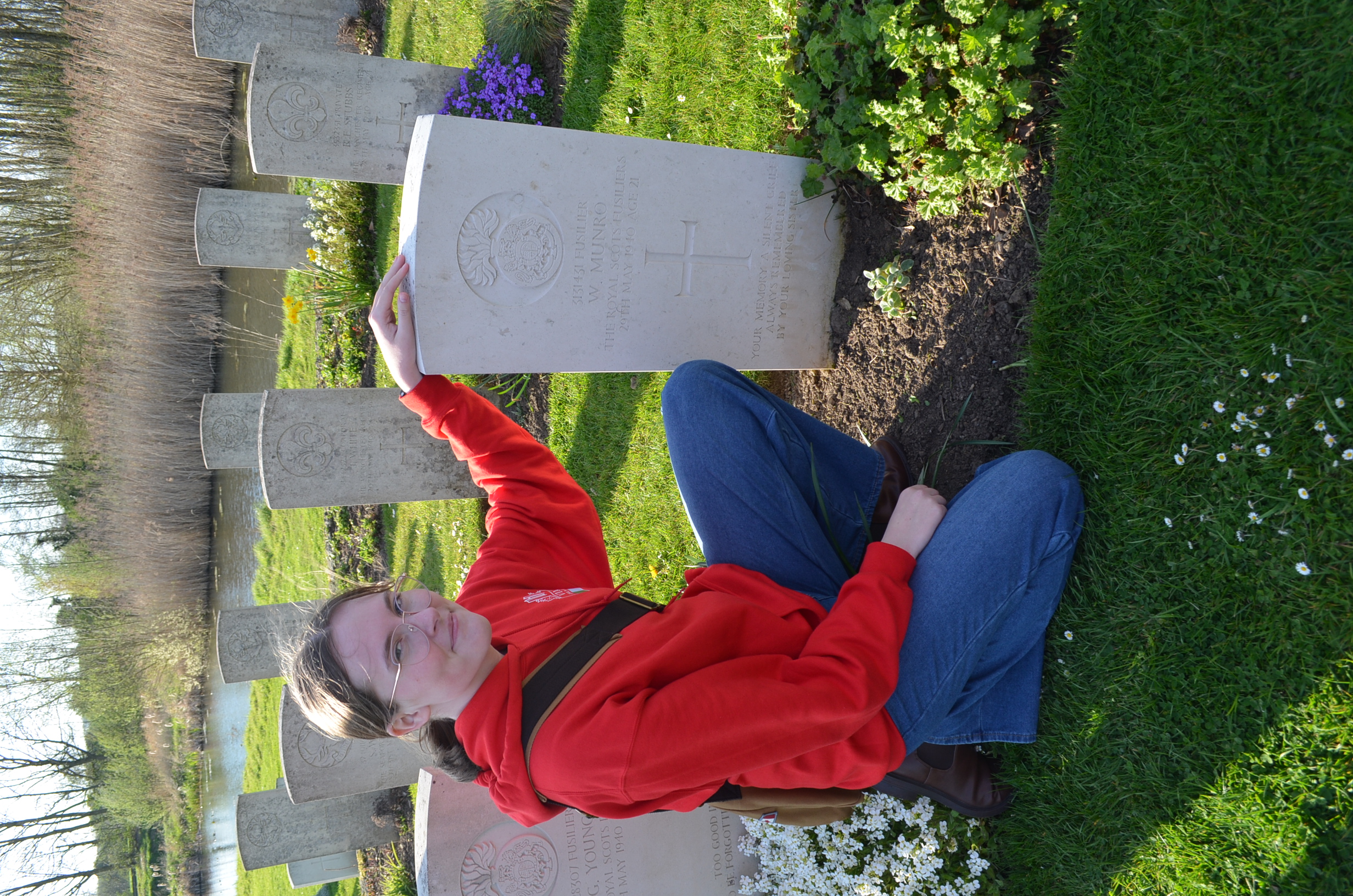
“Today was technically our first program day but it consisted mostly of travelling and visiting one cemetery before turning in early. Despite that, it was still a lot more weighted than I thought it would be. Travelling was smooth, everyone is super lovely and it’s looking to be a great program for all involved! On the topic of the cemetery, we visited the Bedford House Cemetery in Ypres, Belgium! Upon walking into the gates, a hush fell over all of us, almost like how you instinctively hush your voice when entering a library. We were given time to walk through the cemetery and it was so quiet that I felt hyper aware of how I was moving through the pristinely manicured landscape that was home to a few thousand graves. Once we had roamed sufficiently, everyone gathered in a raised semi-circle style area that hosted Second World War graves. I’m not quite sure what led me over to the area, but as I walked to it, I saw a headstone with the name W. Munro. He is a very distant relative of mine and I was a little shocked at first because I wasn’t expecting to see a grave with a familiar name over in Belgium. As I mulled over it, Sean gathered us together to discuss how we felt being in the cemetery and some shared thoughts. Once everyone who wished to share had shared, Sean mentioned one last point which was that we will inevitably at some point become desensitized to the cemeteries, and that it is not a bad thing, but that we should remind ourselves if we do, of how we first felt walking into the cemetery, and to humanize the graves ( to see them as humans and not graves). The weight of his words accompanied by the shock of finding a distant relative left me emotional to say the least. I had no words to describe the feeling. It was such a surreal experience, one that cannot be felt unless you experience it in person for yourself. Photos cannot do it justice. It was such an impactful moment, one that has made me incredibly aware of the privilege we have to be spending this week here in Belgium and France and I hope to keep these moments in mind as the program progresses.”
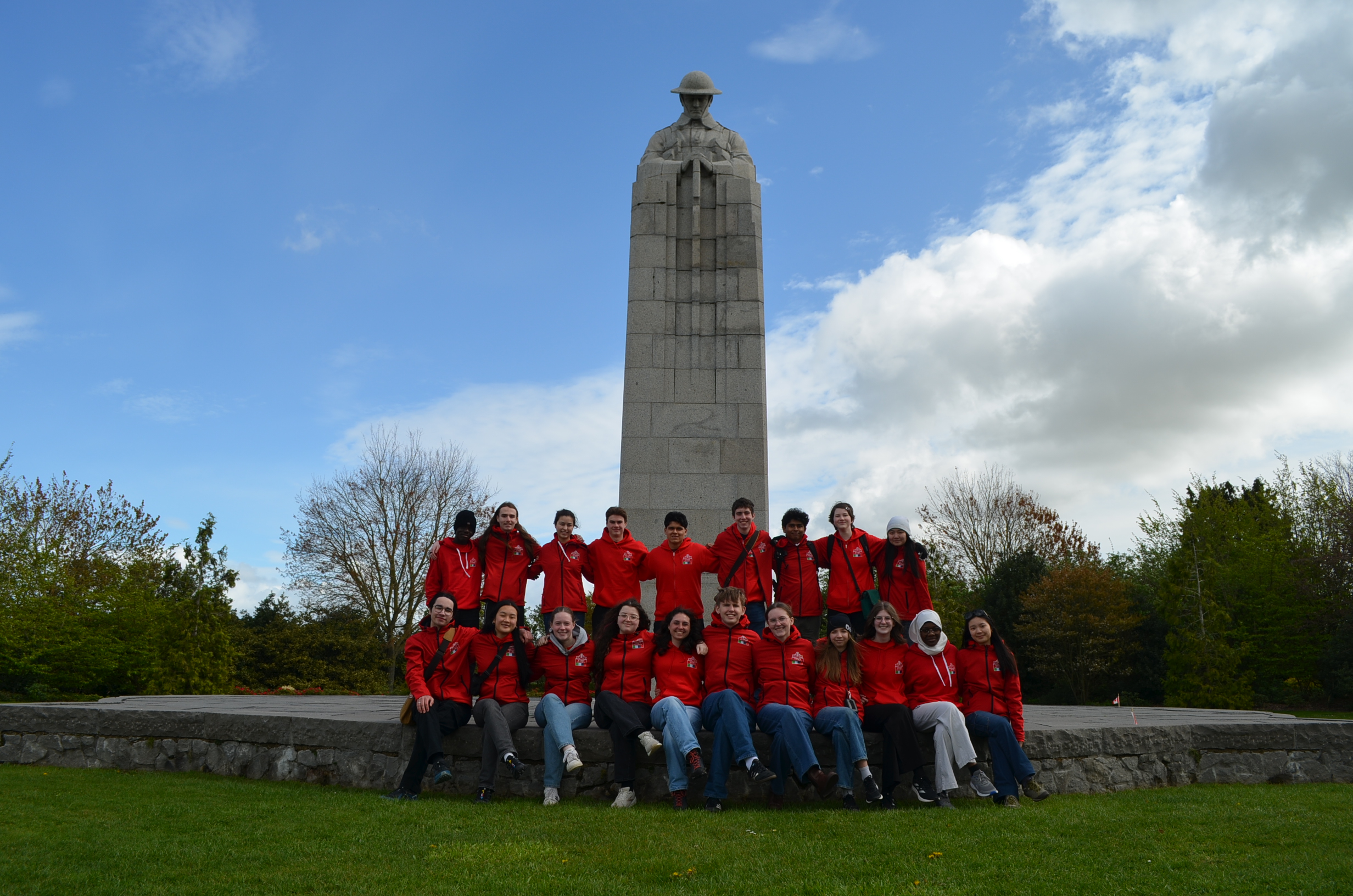
Today marked the second day of the 2026 Vimy Pilgrimage Award program. Students continued their exploration of Ypres, visiting key First World War sites including the St. Julien Canadian Memorial (the Brooding Soldier) and the Passchendaele Museum.
Today, Danielle, Joseph, Amelia, and Jasmine shared their reflections on the day’s visits and the themes explored.
Danielle
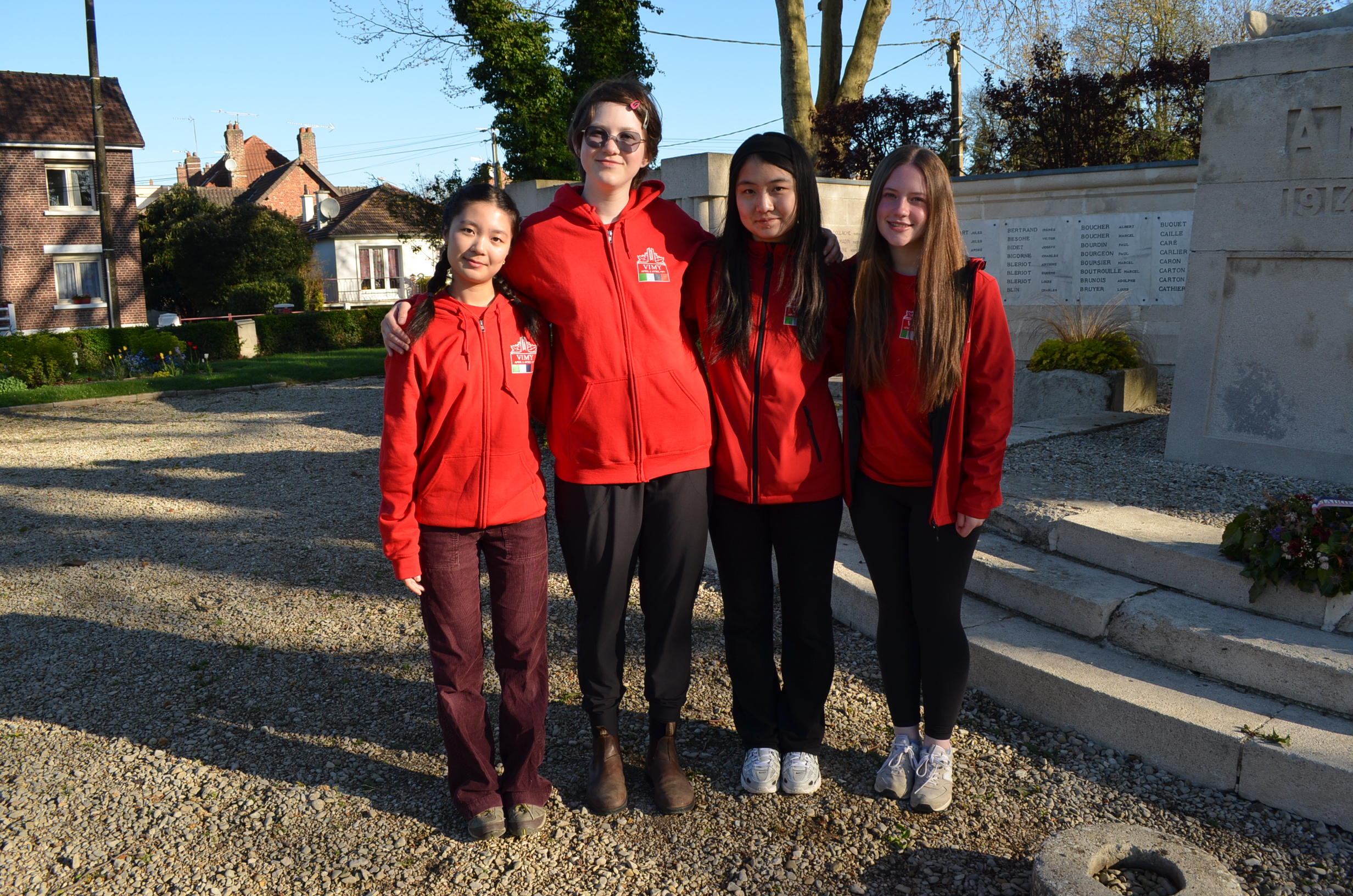
Today being our first full day of the program has been such a shock. Everyone is always asking which cemetery or memorial was our favorite. For me throughout the day seeing six different sites, they all accumulate into a large impact. It was one thing yesterday to see one cemetery which was already huge and put the sheer amount of sacrifice into perspective. Then to see the same thing six times over. Some sites even had graves with twenty soliders resting there. Then a foot away would be another grave with twenty. It really puts everything into perspective like I have never experienced. Its been hard to grasp and without personal experience we can never understand the full scope of impact the first world war had. However, the education team asks really good thought provoking questions. So far, its a lot of information but presented in a very digestible manner.
The cemetery that had really stuck out to me was Essex Farm Cemetary. We saw the grave of a 15 year old V. J. Strudwick. It is unimaginable to me to be younger than myself right now and serving in a combat role. Seeing his grave had led to many questions beyond his young death but about what he wouldve endured and the immense emotional strain this would put on such a young kid. We had also touched on what his home life and community must've been like to have motivated him to lie to join up so young. It had also made me reflect a lot on my privledge. For me to be older than him and visiting on these sites on a program versus his situation even younger than I am is very hard to understand. There really is no way to articulate the true weight of this experience and the story of Clifford Robinson Oulton.
I did also enjoy the Passchendaele Museum. I liked the interactivity as the experience included an audio guide, although with the museum exhibitions themselves. Through these kinds of activities, I have been able to build off of my previous knowledge from cadets and family stories and ask questions. It was nice in the museum being able to engage with the education team in this way, talking about both large operations but also little details in exhibitions.
Joseph
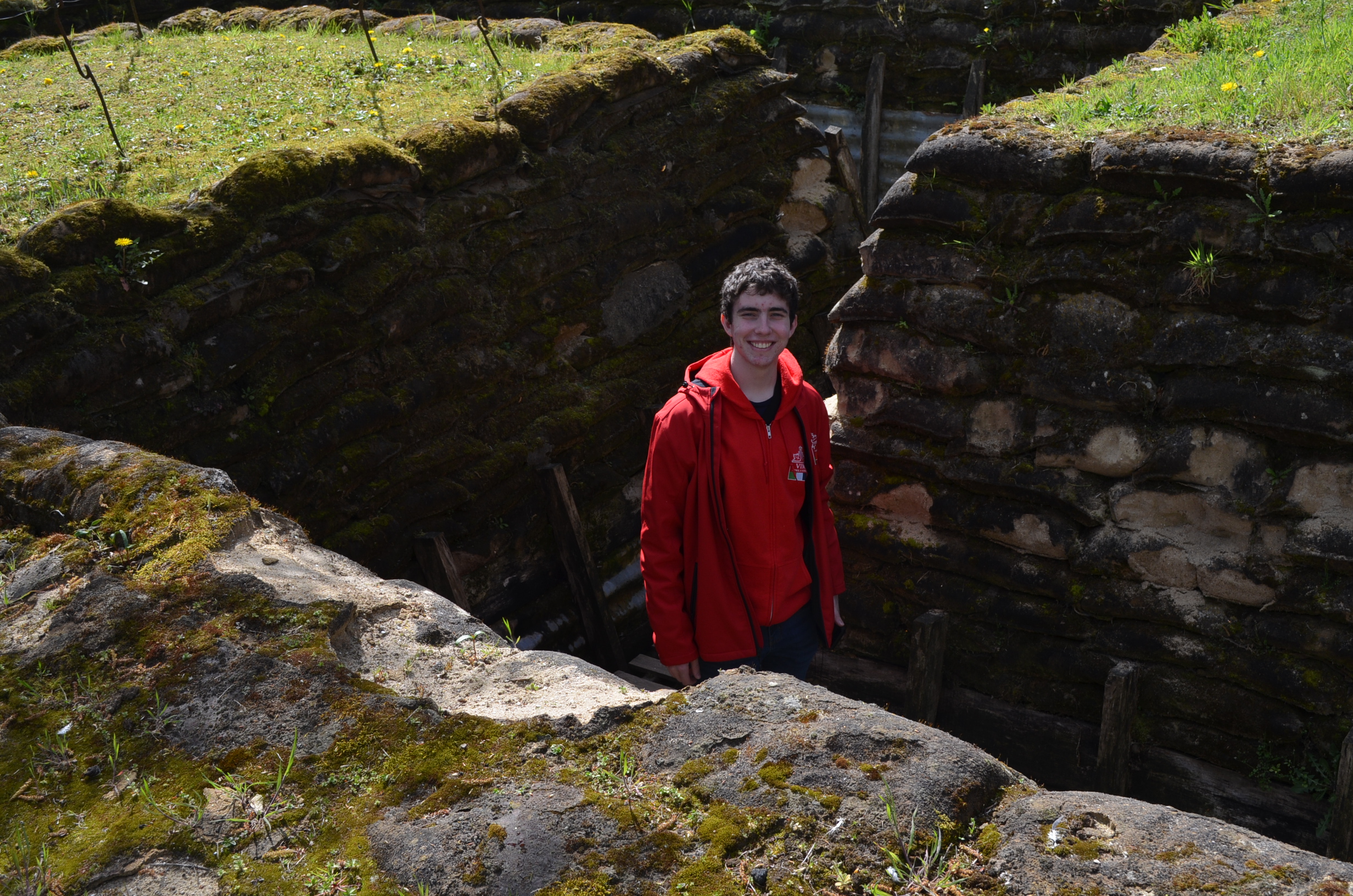
Today, we got to visit the Passchendaele Museum, a stop I had been looking forward to for a while now. My Great-Grandfather James “Jim” McQuinn fought there, and I wanted to see what the area is like. We got to explore replica trenches and dugouts, full of scenes of what was happening at the time. It was such a unique experience to get to see places where my Great-Grandfather would have lived and worked, visualizing them full of mud, water, and exhausted soldiers. From what I know, he never talked to his family about his time at Passchendaele, and never married for twenty years after the end of the First World War. I had never before realized just how intense his time there must have been, until today. It was interesting to see how much the area has changed fromn when he wad there, it's now so lush and full of life, a stark contrast to the muddy, crater pocked wasteland it was for him. We watched a video of the front moving over time, and it was almost painful seeing the death counter count up to 125 000 people. Two of the quotes I saw at the museum today really stood out to me, one by Ernest Black: “I spent thirty-one months in France and Belgium, and I would rather do all the rest all over again than those six weeks at Passchendaele”, and the other by Siegfried Sasson: “I died in hell - (They called it Passchendaele)”. For me, these quotes really highlighted how horrible Passchendaele was for them. I had such an amazing experience at the museum today, I learned so much and it helped me better understand the experience of my Great-Grandfather in the First World War.
Amelia
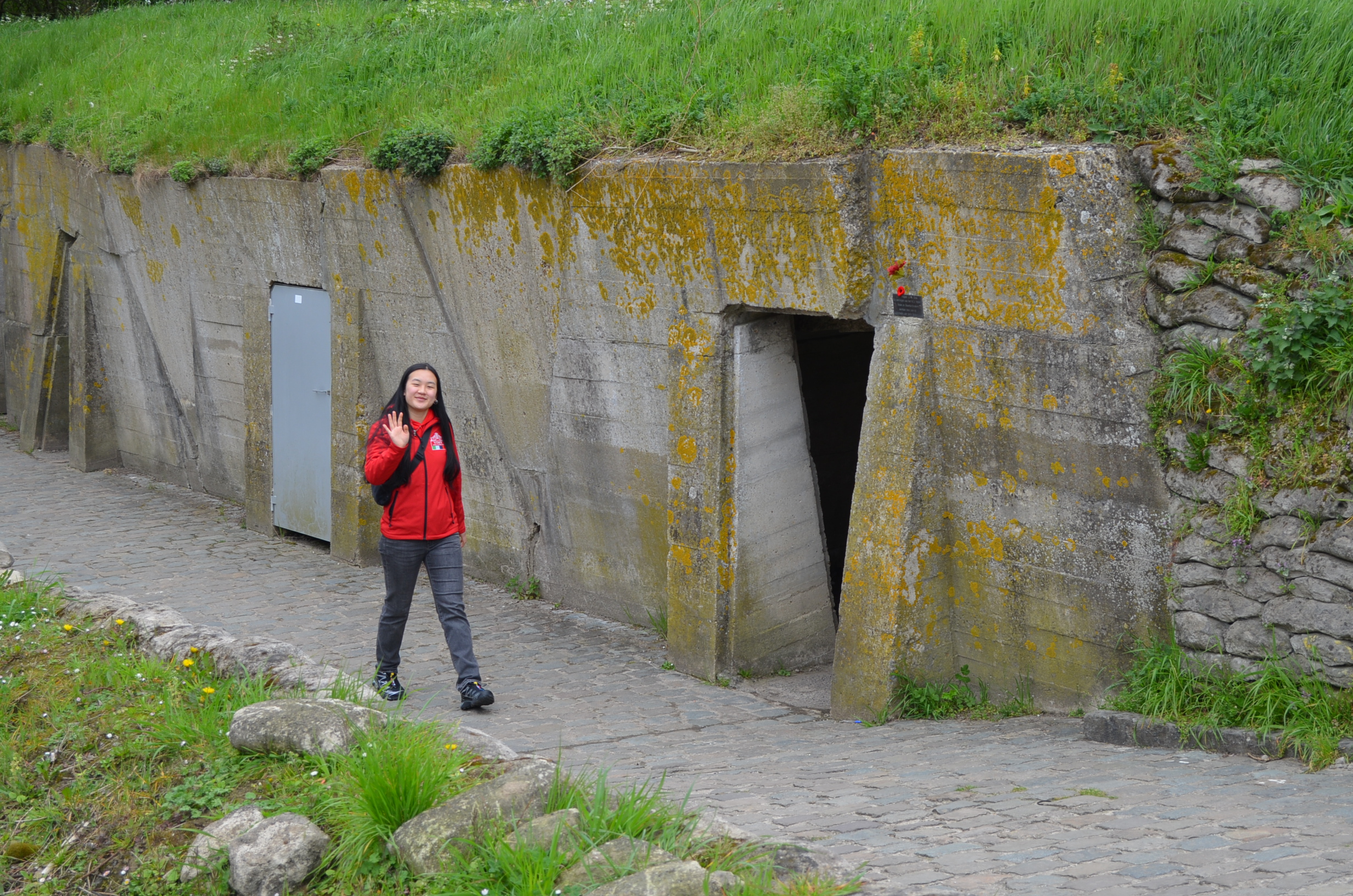
Today, on Sunday, April 4th, was our first full day of the Vimy Pilgrimage Award program. After exhausting travel days on Friday and Saturday, I was excited to visit sites in the Ieper region in Belgium. My group had the chance to do our field presentation at the Yorkshire Trenches on why soldiers enlisted in the First World War. As I stood with my group, I felt so connected to the other 19 participants in that moment. We had all just met for the first time in person just one day ago, and came here from different areas across Canada, but I could tell everyone was equally engaged, passionate, and eager to learn about First World War history. We went to a variety of sites and were able to see graves for British, Canadian, and German soldiers, all honoured and well-kept. One of the soldiers we visited enlisted underage and died at the age of 15, which really put into perspective how different life was over 100 years ago. It was also interesting to see how the cemeteries, memorials, and battlefields were interspersed among the businesses, farms, and fields along the highway and in the Belgian countryside, as though the past and present were coexisting. I can’t wait to experience France and the rest of the program with my fellow participants.
Jasmine
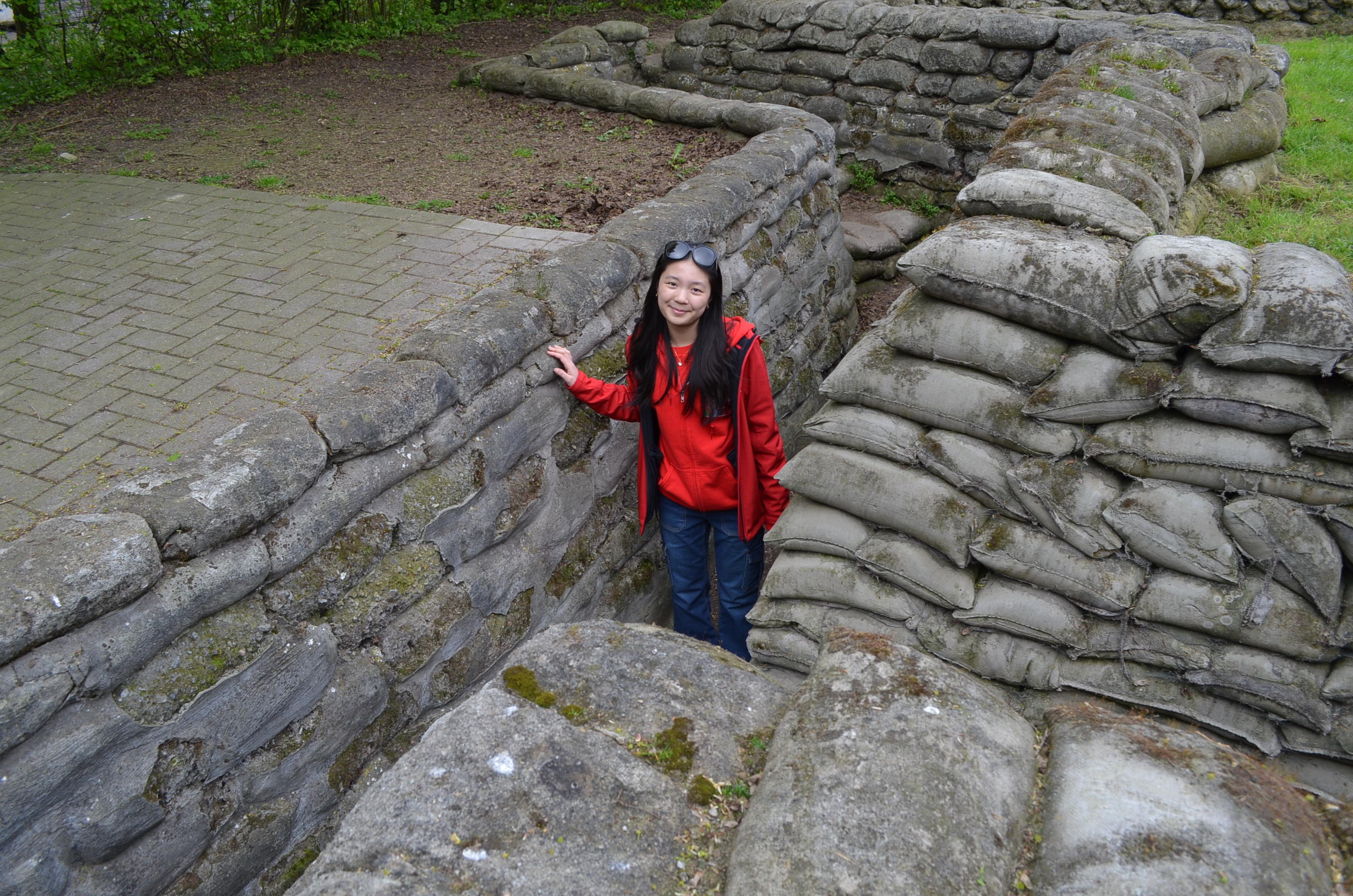
On the second day of this program, we had the opportunity to visit many cemeteries and museums. The two locations that stood out to me are the Langemark German War Ceremony and the New Irish Farm Cemetery. The Langemark Cemetery gave me a new perspective of the war dead and how the Germans commemorated it. Throughout the walk and sharing, I was able to reflect on something Sean said yesterday, which was to visualize the graves as someone actually standing there. Some of the grey stones had around twenty names on them, and I just can’t imagine how many people would be standing there. The whole layout of the cemetery, with the German trees and the crosses throughout, made me feel more solemn and reflective on the other side of the war. The other place that stood out to me was the New Irish Farm Cemetery. The burial of the Chinese Labour Corps felt sort of surreal seeing them buried on the same land as everyone but still separated from the soldiers. I was surprised that many Canadians did not know that so many of them were being transported on the train, and it also helped me appreciate that I am living in a time where everyone is more accepting and willing to learn about these topics as a society. When we were reading their Chinese names on their headstones, I also felt sort of regretful in not being dedicated to learning Chinese words, as I could only read part of their names. Overall, today’s visits to the different cemeteries and museums helped me learn new perspectives of the war, reflect on stories of individual soldiers, and have given me more food for thought.
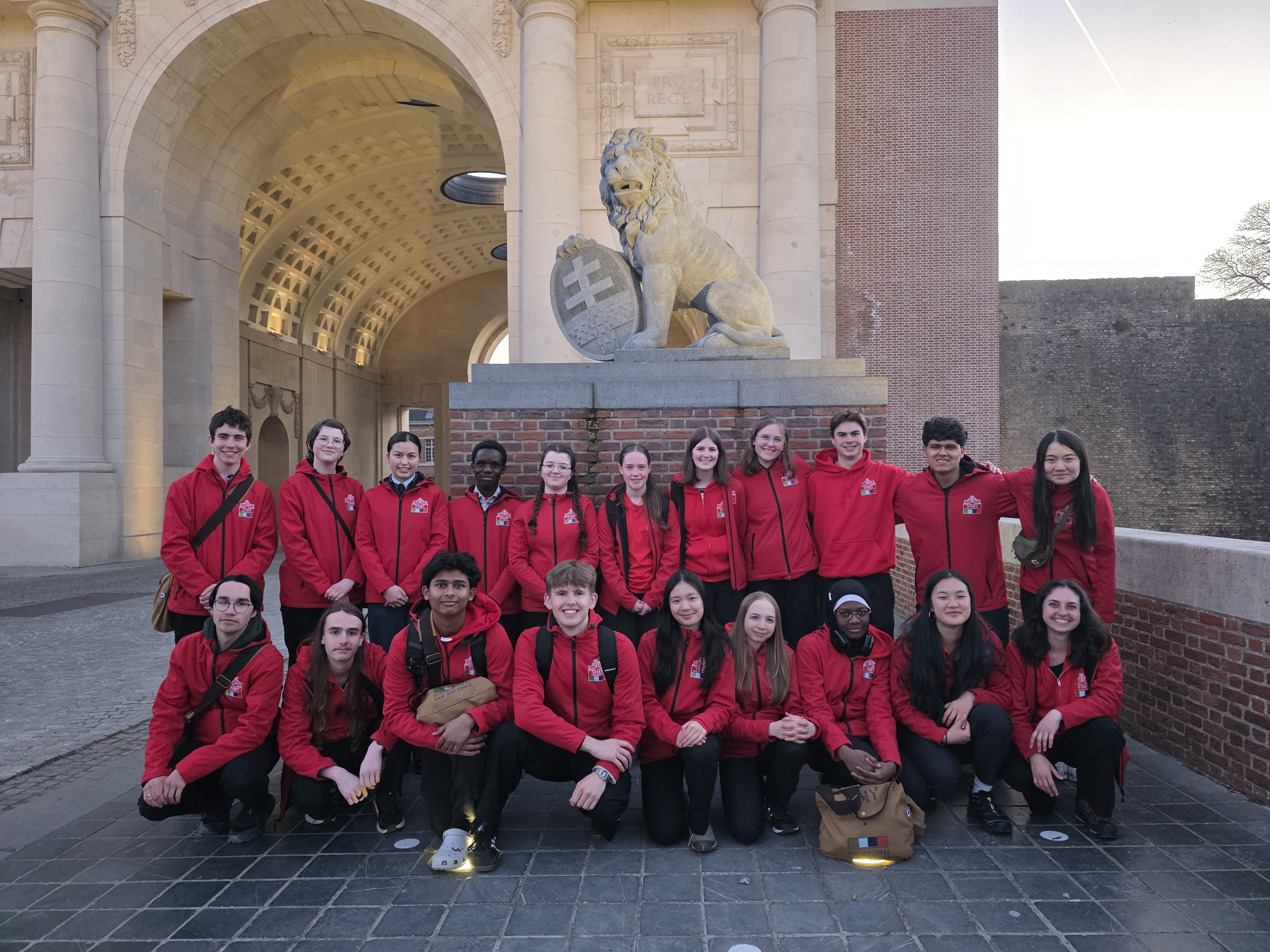
On the third day of the Vimy Pilgrimage Award Program, students visited a number of First World War sites, including the Christmas Truce Memorial in Messines, Belgium. They also visited several cemeteries, including Tyne Cot, where some students delivered their soldier presentations, and stopped at the Canada Gate at the Passchendaele Canadian Memorial.
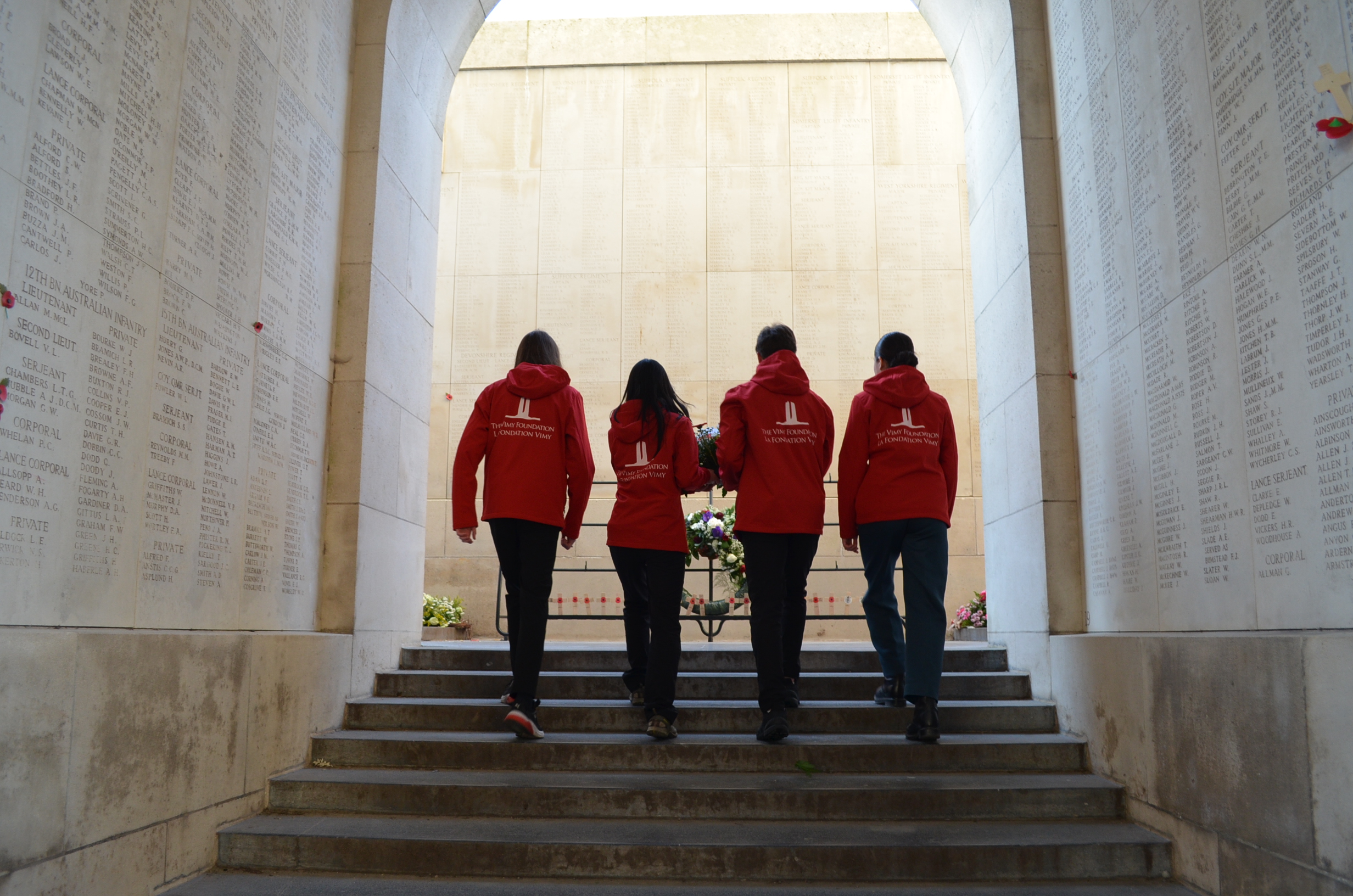
The day concluded in Ypres with a visit to the Menin Gate, where students attended the Last Post Ceremony. During the ceremony, Jackson, Jessy, Cynthia, and Jasminelaid a wreath, and Emily read the Act of Remebrance.
Today’s reflections are from Elyse, Mia, and Ella B., andAbhiraj.
Elyse
.jpeg)
Aujourd’hui, j’ai fais ma présentation d’équipe sur la vie quotidienne des soldats au mémorial de la trêve de Noel. Je présentais plus en particulier sur les conditions physique avec les problèmes et les bonnes choses qui arrivaient aux soldats qui ne faisaient pas partie de la routine. Pour ma recherche je suis allé au musée canadien de la guerre et j’en ai appris énormément sur le sujet. Je me revoyais enfant, ne pas vouloir aller à ce musée et maintenant, je suis à Ypres, à présenter la vie de ces mêmes soldats que j’ai ignorés toute mon enfance. Rendu là-bas, je réalise que même si connaître les horreurs de la guerre peux ne pas être confortable, être ignorant ne fait que nous rapprocher de refaire ces erreurs du passé. J’ai adoré faire les recherches pour ma présentation, car j’ai pu voir une face différente de la guerre que les corps et le sang. Les différents travaux que nous avons fait pour le programme m’a fait réaliser l’importance de se souvenir de ces hommes. Nous visitons des cimetières et nous allons peut-être nous souvenir d’un nom ou deux, mais pour certains des soldats, même leur nom s’est perdu dans le vacarme des obus et de l’artillerie pendant la guerre. Aussi, j’ai remarqué comment semblable les soldats étaient à moi, ils aiment l’humour, font du sport, envoie des lettres à leurs parents, etc. Pendant ma présentation, je m’imaginais au milieu de ces d’hommes en train de rire à des blagues pour garder l’espoir que la guerre finisse enfin. Des fois, j’ai l’impression que ces soldats sont vu comme de simple statistique dans un musée ou dans un livre, alors de pouvoir les montrer sous un angle plus humain aux autres participants m’a fait me souvenir que ces hommes ont des noms, des histoires et des familles, qu’ils n’étaient pas de simple pions dans un jeux d’alliance partie trop loin. En bref, ma présentation m’a rappelé qu’avant d’être soldat, ils sont des hommes, ce qui est important pour moi, car j’imagine mon frère ou mon père, qui ressemblent beaucoup à ses homme, et j’haïrais si ils seraient déshumanisés comme les soldats de la première guerre mondiale.
Mia
At Menin Gate, we had the chance to witness the last post ceremony. The second I heard the familiar melody of the last post, I was instantly taken back to school. I was standing in my auditorium, wearing my cadet uniform and lowering the Canadian flag. The next second, I was ten years old. I was in Minto Armoury in western Winnipeg, watching the remembrance ceremony on the drill deck from above. And the next, I was a child again. I was playing and jumping around in the November snow, paying no mind to the service that was happening in Vimy Ridge park near downtown Winnipeg. How far I’ve come, how much I’ve learned since each of these memories. Different places, points in time, levels of understanding. I knew nothing of the war as a child. It seemed as distant as the stories I read in books. Innocence of the child is a beautiful thing. Unfortunately, innocence must be lost at some point in life. Now that I understand more of the true horrors of war, especially from this trip, I feel increasingly more and more dread. The pit in my stomach grows with every site we visit, every point in the war immortalized in space and time, never forgotten. It lived on in the landscape. The wind whispered and told of how the hills knew. They never forgot. The terrible and unavoidable path of the soldiers came to reality. There was nothing that could come in the way of fate once the boots hit the ground of the battlefield. Now, over 100 years later, innocent lives are still lost to war and violence. Countries lay in ruin, people lose lives on the daily. Warfare advances similarly to how it did in the 1910s: even before running water and electricity, tanks, guns, and shells were used to kill people. And even today with various problems of homelessness, hunger worldwide and the earth slowly becoming inhabitable, we’re still looking for the most effective ways to kill. Even now, over 100 years later, have we really changed all that much?
Ella B
Throughout the trip so far, I’ve been reminded a lot about how lucky and privileged I am. We’re here in Europe to learn about many heavy topics, like the horrific living conditions soldiers dealt with, the mistreatment of psychological issues in wartime, and the deaths of civilians during military conflict (to name a few), yet we get to eat healthy meals, go to sleep in safe and comfortable beds, and experience this whole program knowing we’ll be able to return home safe in a week. Millions of people came overseas in the 1910s, not knowing for certain if they’d ever go back to their families, their friends, or their homes. Despite sharing some things in common with these people, such as age, religion or hometown, most of us will never truly relate to the experiences that they lived through. We’ve been walking through the same areas as they did over 100 years ago, yet our circumstances and daily lives in these places couldn’t be any more different. Another thought I haven’t been able to shake is the privilege we all have to come see so many graves in person, as morbid as it might seem. We were recently taught about how the British (and the rest of the Commonwealth) made the decision not to repatriate the bodies of the fallen back to their homelands. This decision has not been universally celebrated, and today we learned about a few instances of grieving families attempting to return their fallen soldiers back home themselves. While the decision against repatriation is a very nuanced and controversial topic, I can imagine that being separated from a deceased loved one after their untimely death would be utterly heartbreaking. I myself have a British/Canadian relative who was killed in action during World War One and is buried in France, thousands of kilometers away from most of the family. I know several of my relatives have been able to travel to France and visit his grave, but I can’t imagine that being an option for the vast majority of families with a similar story to mine. It’s saddening to think about how many families grieving the loss of a child, sibling or partner never had/never will have the chance to grieve in front of their loved one’s resting place. Everyone grieves differently, and based on discussions I’ve had with members of my community and things I’ve felt myself, a lot of people need to be able to say a final goodbye to their loved ones in person in order to fully process their loss and gain closure.
Abhiraj
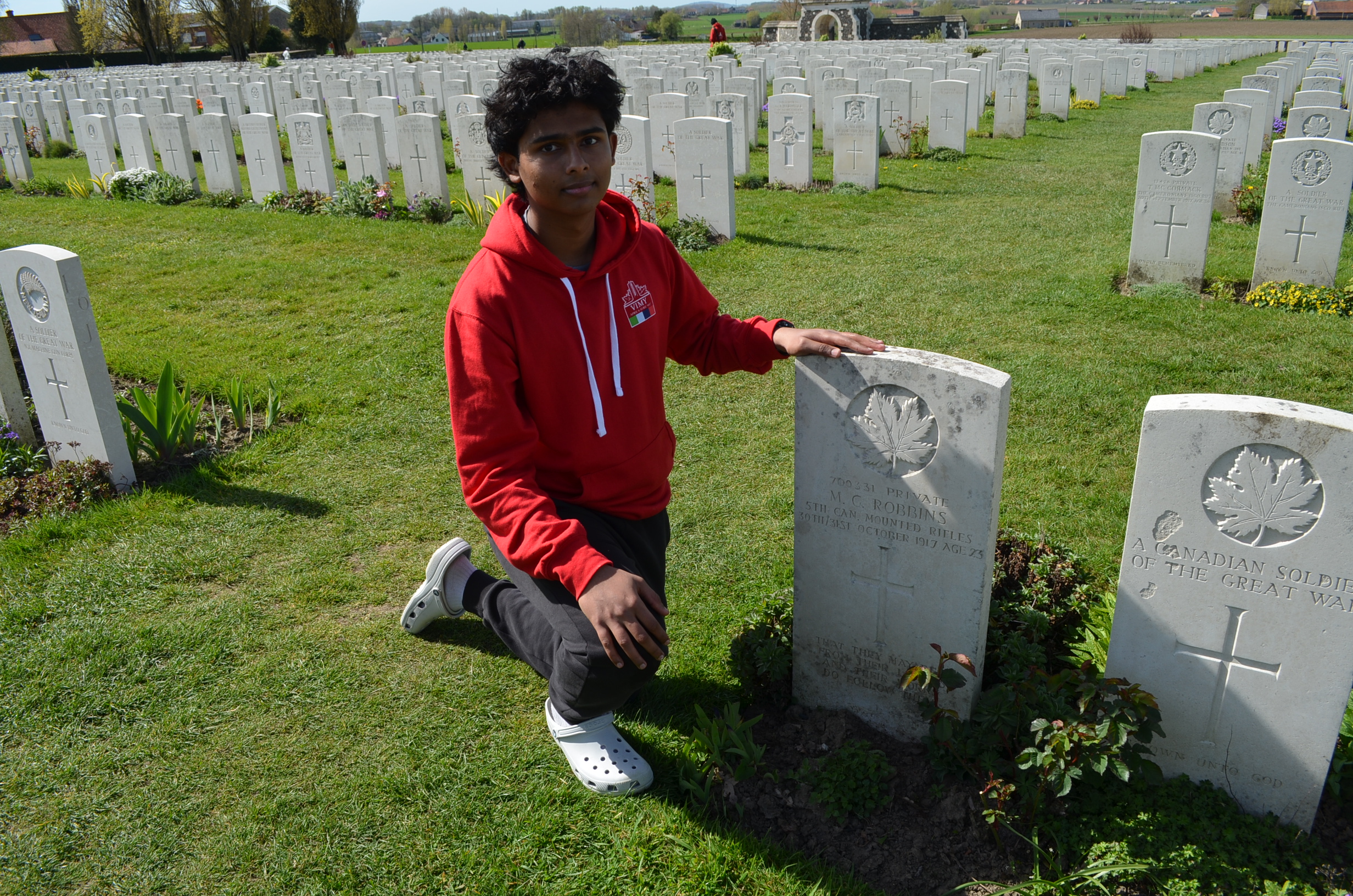
Today was our last day in Belgium, and it began early as we travelled to a football truce memorial and a crater site caused by humans to act as a defending post for the First World War. Then we went to see a WW1 bunker that was nearby. After that, we went to 2 more sites, then we finally reached Tyne Cot Cemetery, the largest Commonwealth war cemetery in the world. My friend Khalid and I had chosen to do our soldier presentation there. I was super excited. Before presenting, Sean gave us a brief overview about the history of Tyne Cot. It had 3 bunkers and was used as a defending point by the English. Walking through the rows of white headstones felt quiet and powerful, with the scale of the cemetery immediately standing out, with all the graves’ headstones. Finally, I presented about my soldier, Private Mortimer Giberson Robbins, a Canadian soldier who served with the 5th Canadian Mounted Rifles. Sharing his life and sacrifice while standing among soldiers who fought in the same battles gave the presentation a completely different meaning. I chose to also recite a poem that I crafted about Private Mortimer’s life, and the experience felt very magical and fulfilling, and I was even able to etch on his gravesite. This was something that I really cherished, as I would be able to keep his memory with me later on as memorabilia.
Later in the day, we travelled to Menin Gate Memorial in Ypres. Before the ceremony, I stopped at Steve’s shop, a small store filled with wartime historical items, and I bought a shell-cased candle for my history teacher, who loves collecting war artifacts, and Steve’s shop.
Finally, at the end of the day, we attended the daily ceremony at Menin Gate, which was again a very magical experience. I loved my time in Belgium, and I am really going to miss it.
I have attached my poem below:
The Life of Private Robbins
Just twenty-two years old, his life likely felt ordinary,
He did his duty at the time day to day without any worry.
It was autumn, and the Great War had broke out.
Mortimer, a young patriotic soul, came back to his land of birth,
He enlisted for the army, and helped to change the face of the earth.
2 years passed, and the war we all thought was short was at an all-time high,
Mortimer, now no longer a young carpenter, was now a private.
Fighting on land and battling in trenches beneath the ground, helping Canada in Europe,
He continued to follow orders, and moved on to Passchendaele with pride.
He was a loyal citizen to his nation, a young boy from New Brunswick who was about to
have his last stride.
Mud was super deep; it was very hard to walk,
But Private Mortimer and his squad ran, persevered, and continued to move and talk.
October 1917, Passchendaele. Deadly shell fire greeted his crew,
The New Brunswicker and Canadian Private Mortimer was one of the few.
Far away from the oceans where he once used to reside.
Now he rests where poppies grow and silence fills the air,
His name carved into stone so future generations may care.
More than a soldier, more than a name we recite today,
He was a young man with a life that slowly faded away.
Though oceans separate his home from where he lies,
His memory lives on each time his story is told and never dies.
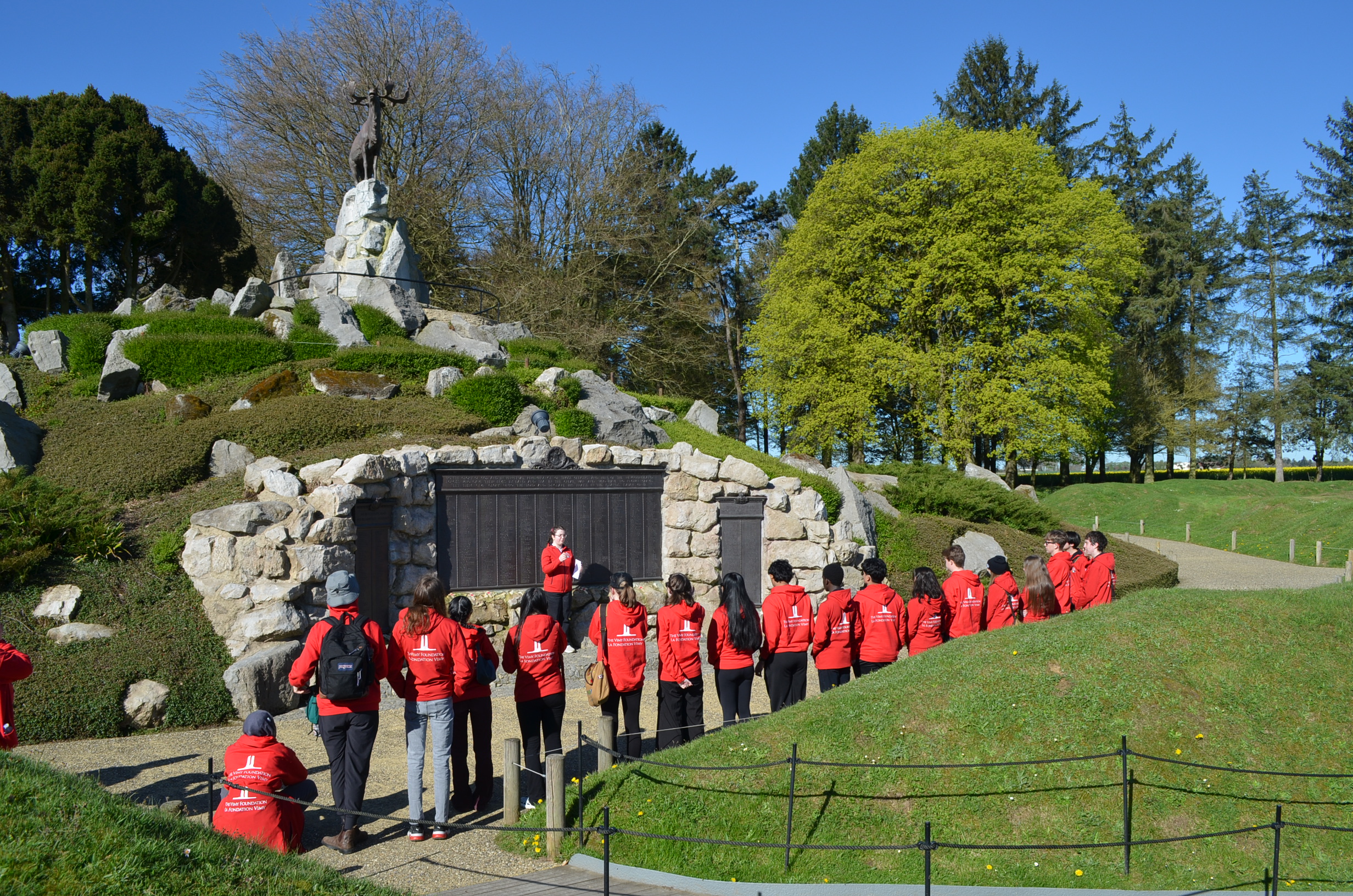
On the fourth day of the Vimy Pilgrimage Award program, students travelled to the Somme, where they visited the Thiepval Memorial to the Missing of the Somme.
They were also given a guided tour of the Beaumont-Hamel Newfoundland Memorial by a Veterans Affairs Canada guide, where they learned more about the experience of the Royal Newfoundland Regiment.
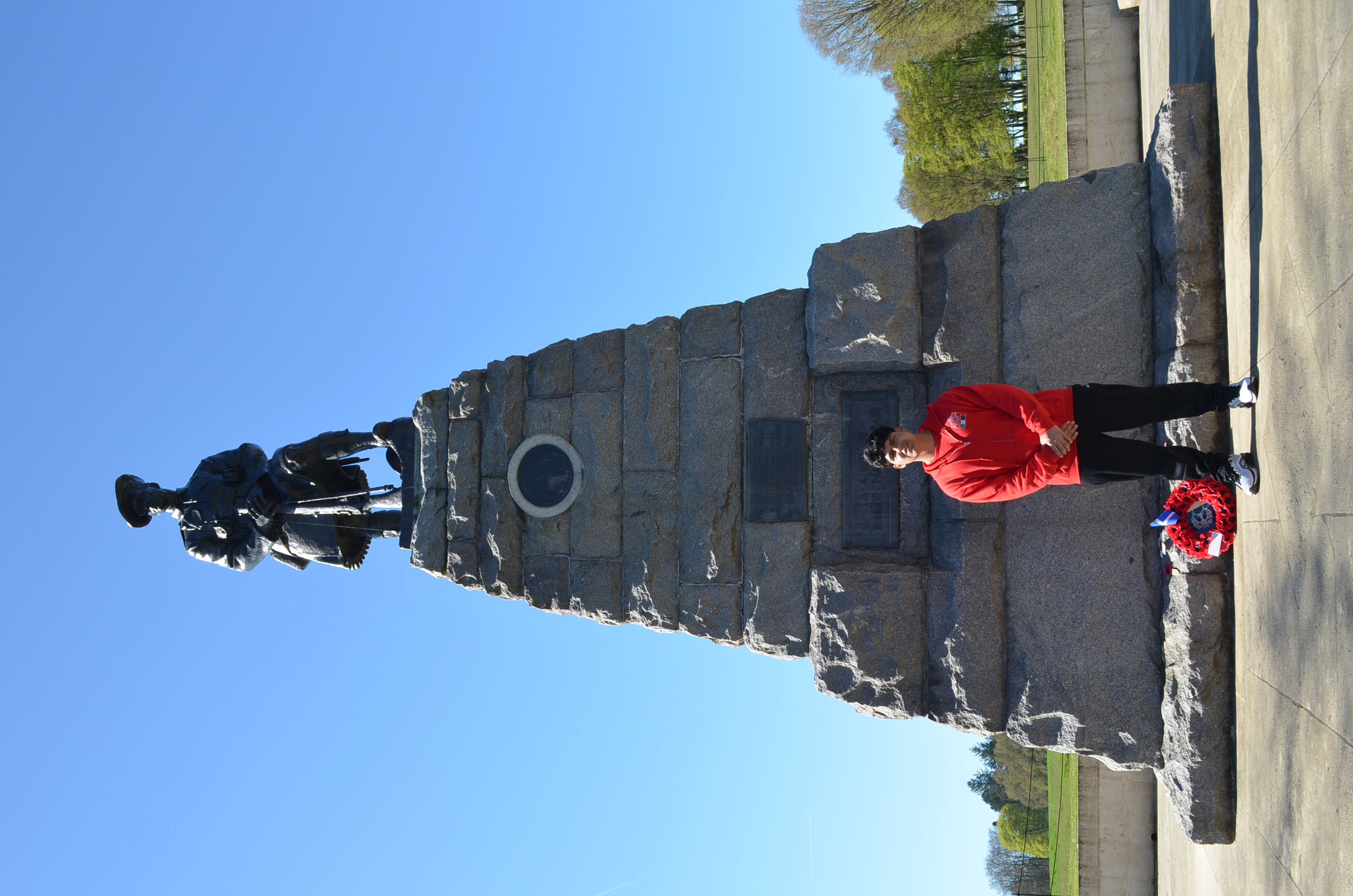
During the day, students visited additional memorials across the Somme battlefield, including the 51st (Highland) Division Memorial at Beaumont-Hamel.
Today’s reflections are from Ella C, Connor, Brogan, and Sophie.
Ella C.
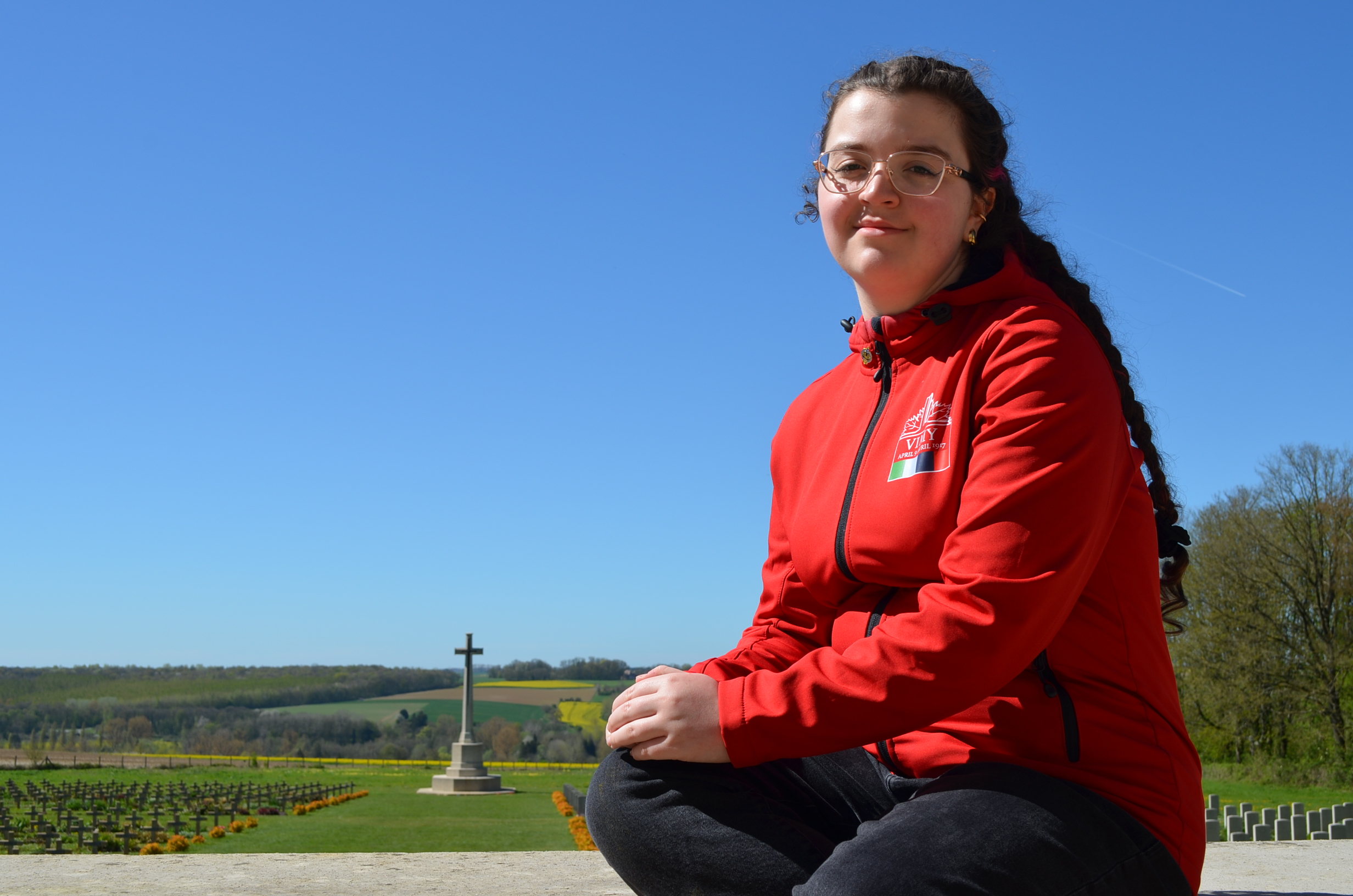
Today I walked through Beaumont-Hamel Newfoundland Memorial, the largest Newfoundland and Labradorian memorial in France and Belgium. Throughout this trip I have been grateful to visit many cemeteries and memorials, but none have moved me as deeply as this one. I am thankful that throughout the trip I have been given more nuanced perspectives on the past, and how much of an impact it has had on my understanding of the war.
This is especially true for my experience at Beaumount Hamel. As a proud Newfoundlander, standing where so many of my own people fought and fell is something I can hardly put into words. I had the honour of presenting Corporal Richard J. Neville's life while I was there, a soldier from my town whose story is passed down in song. What stayed with me most was not just learning and speaking about his service, but his life as a person, his identity, and everything he left behind.
This was truly the highlight of my trip and I know it will be a memory I carry with me for the rest of my life. I was overcome with emotion and found myself crying during my presentation, and I have no shame in that. I am proud to have felt such a deep connection to my past and to those who came before me.
What deeply resonates with me is how this program goes beyond textbooks to educate others about the Great War. I have profound gratitude to the Vimy foundation for allowing me to feel and experience my emotions in new found ways, and expand my historical knowledge by being physically present. I am eternally grateful to be able to make this journey in peace and security, while just over 100 years ago, those who walked this same ground were met with uncertainty and bloodshed.
No experience to me has yet to feel like walking the Beaumount Hamel grounds. I felt a powerful sense of courage, sacrifice, and pride. These were not distant figures in history, but young men from communities like mine. It reminded me that I come from a proud and resilient people, not defined by limitation, but by perseverance, strength, and an enduring spirit. Beaumont-Hamel to me is not just a place of remembrance. It is a reminder of who I am, and the legacy and honor I carry forward as a daughter of Newfoundland.
Connor
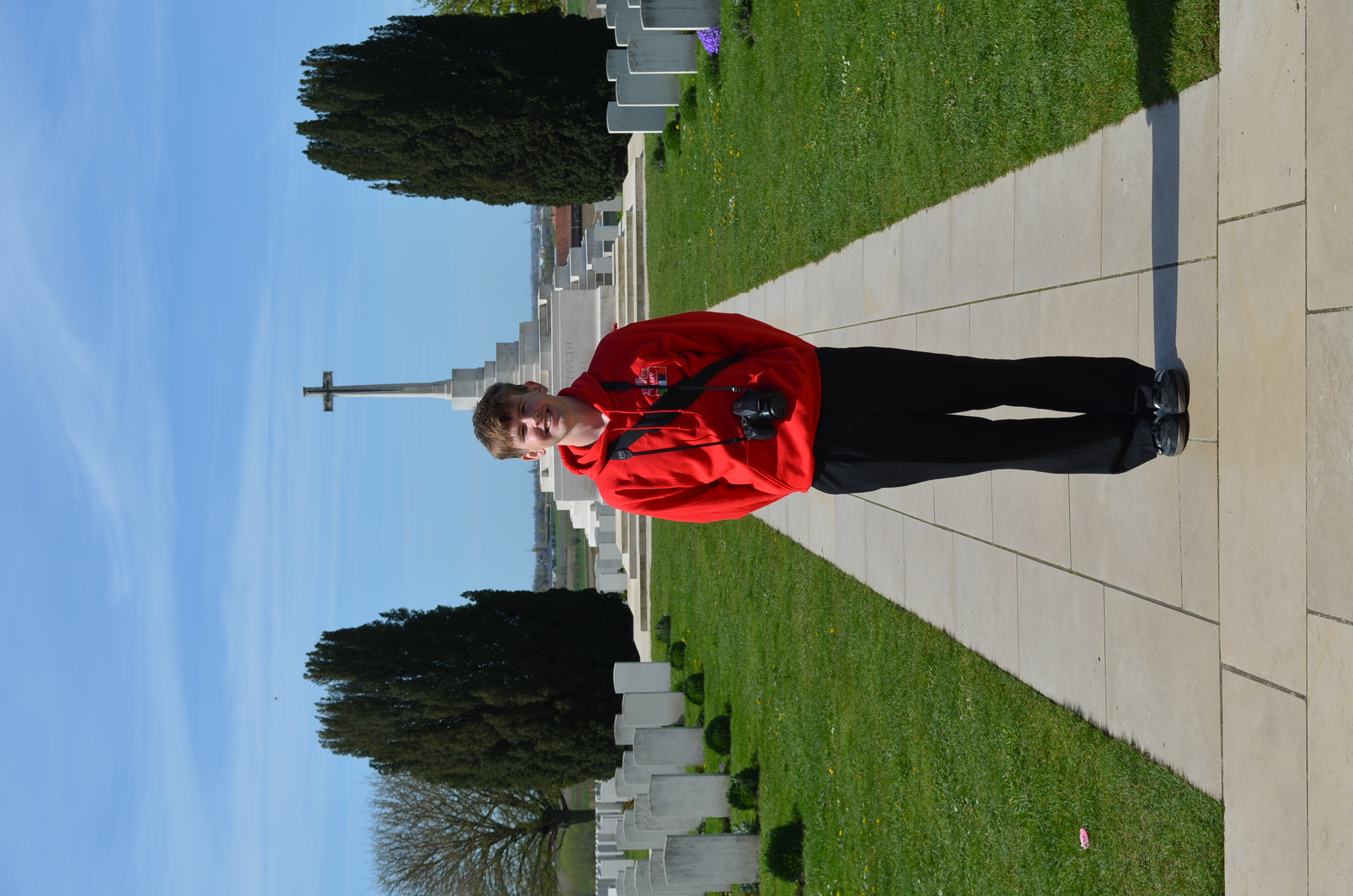
Today, I had the absolutely incredible and humbling experience as a Newfoundlander of visiting the memorial dedicated to the Royal Newfoundland Regiment, at Beaumont-Hamel. Seeing the list of all those familiar family names and above all, my great-great-great-uncle’s name, was very emotional, to say the least. While at the memorial, I had the honour of presenting a biography and reflection of my great-great-great uncle that I have spent the weeks prior to my departure researching and preparing. Seeing the trenches, and being able to understand how a battle played out based on the topography of the region really allowed me to grasp an in depth comprehension of an important aspect of the war, one that would be difficult to grasp without being physically present. Amongst the numerous other sites that we visited today, Delville Woods South African memorial left the biggest impact on me (aside from Beaumont-Hamel, of course) As a Canadian, seeing the role that other countries played in the First World War was fascinating. Other countries were essential pieces of the puzzle that is the First World War, and considering that I am most familiar with what consists of the Canadian piece, learning about the South African piece was fascinating. This whole trip to date as been extremely eye-opening and much more dynamic than expected, and I cannot wait to see everything else to come.
Connor also shared the letter he wrote to Charlie, a family member who was killed in France during the First World War.
Charlie,
I write to you 107 years, 11 months and 15 days after you have passed. You died 3992km away from where I first saw you, years ago. You were posed with your parents and brother, wearing your uniform. That picture, I found perched on a shelf at your niece’s house in Calvert, was that taken the day you left? In a few short days, I too shall leave and make the same voyage across the Atlantic that you made, yet for a drastically different reason. You went to war and I go in peace. You left because it was all you knew and I am going to learn. You traveled by water and I will travel by air. You said Goodbye to Leonard at the Port and I said goodbye to his daughter, your niece, my great-grandmother, at the same Cemetery where your name lays, even if your remains don’t. You fought as a proud Newfoundlander, an identity that despite no longer being a nationality, is just as proud. In your face, I see that of my many Great-Uncles, your great-nephews, of my uncle, your great-great-nephew, and of my own. The same big ears, the same mischievous eyes, and above all, the same unfortunate hairline. Charlie, we may never know the reasons as to why you joined the Royal Newfoundland Regiment, nor what you were thinking at the time of your death, but all I, as a Newfoundlander and as your relative, can hope is that you rest easy. That you know that your memory is still alive in Caplin Bay, Newfoundland, even if today that same place is Calvert, Canada.
Brogan
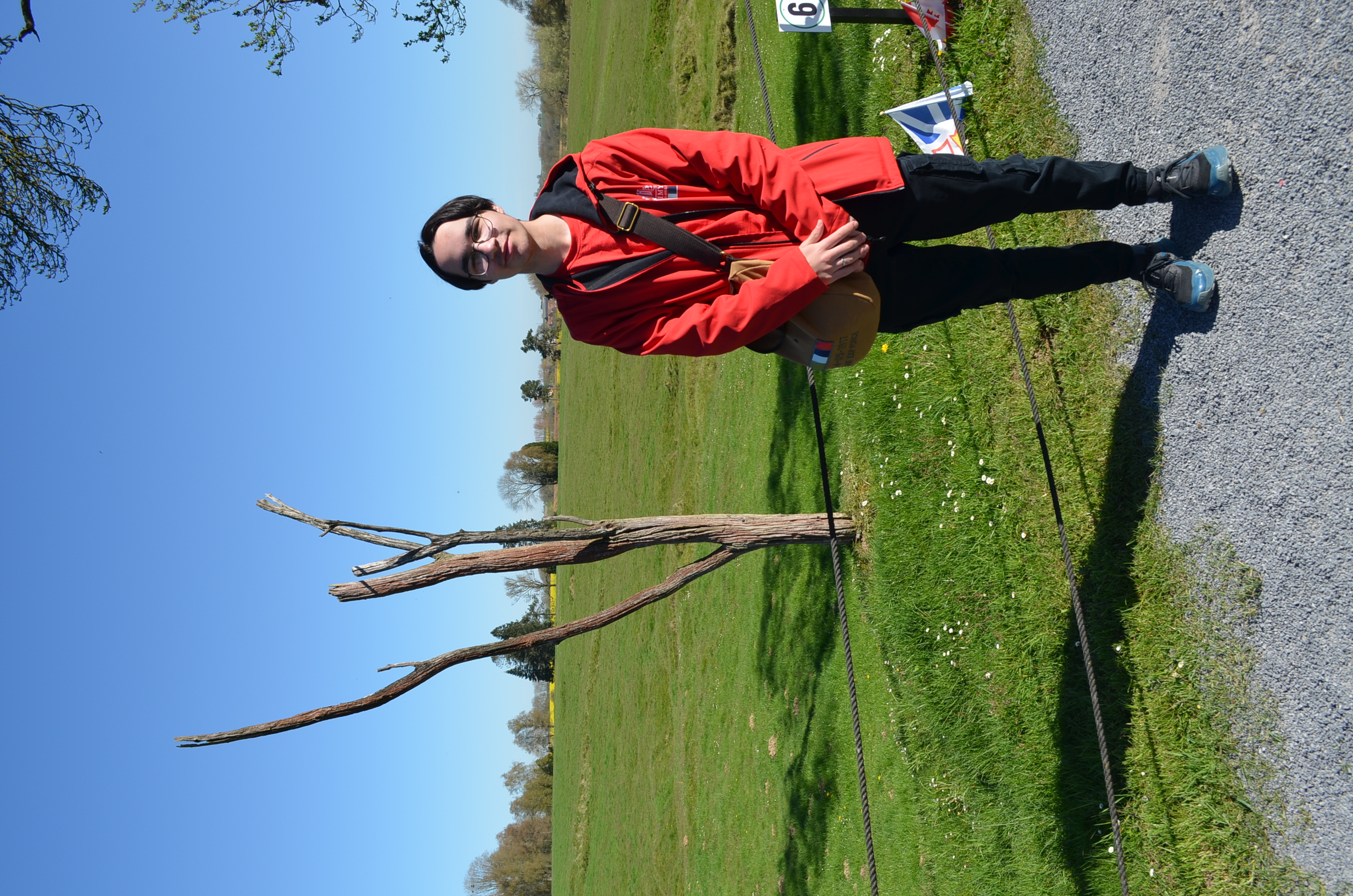
Today was a day filled to the brim with stories and history. It was wonderful to hear the many presentations by my fellow participants and see many more memorials. First was an incredible presentation on the role of women on the front lines at the Peronne Monument to the Dead. The presentation was beautiful, and on an extremely important topic. We then went on a journey to the Beaumont-Hamel Newfoundland Memorial, a very powerful place dedicated to the Newfoundland Regiment of the 29th Division of the British Army. This part of the day was the most memorable for me since that was where I was able to reflect on his and so many other’s lives, and also learn a lot about the Newfoundland Regiment. There, at the Caribou Monument where the names of soldiers of the Newfoundland Regiment who were not able to be buried are inscribed, three of us VPA participants presented our soldier projects, me included. I presented on Lance Corporal John Shiwak, an Inuk sniper who fought under the Newfoundland Regiment. The other two presentations were also about soldiers from Newfoundland. I felt very moved by the presentations as each of the participants presenting had a very personal connection to their chosen soldier. We also went to the Thiapval Memorial, where we got to see the names of 73,367 officers and soldiers who were not able to be buried. The sheer amount of names that were on the walls of the monument astonished me; it was hard to put into words. It made me remember how many names I also saw on the Menin Gate, how many soldiers were not identified and not buried, and how many lives the First World War took. Seeing all these monuments and memorials in person has put all this into perspective. Later, we went to the Delville Wood, the memorial for South Africans who fought during the First World War. There our group shared a fun yet emotional moment, realizing we only had a few days left together. While at this memorial, I truly took into account how special this program is, and how amazing and kind the people around me are. It is times like these that always remind me of the importance of experiences like the Vimy Pilgrimage Award. Over the course of the day, we also visited many cemeteries, reflecting on the roles of Black and Indian men in the Great War as well, such as how Black men had their own unit in the war, the No. 2 Construction Battalion. They were not permitted to fight, but they were vital to the war effort because they built bunkers, bridges, railways, and many other structures. We got to hear the story and see the grave of Vincent Carvery, a Black man who was part of the Battalion. He was known for being rebellious and undisciplined on his record, which led to him being shot by another soldier in 1918. The No. 2 Construction Battalion, and all coloured people in Canada, faced heavy racism from the government and military during the First World War. Learning the story of Carvery was eye- opening. It gave a very real example of what the war was like for a Black man at the time. The Indian Army was their own military force in the British Army, with soldiers of differing cultures and spoken languages coming together to serve in the First World War. We were fortunate enough to see some of their graves at the La Chapelette British and Indian Cemetery. Their graves were in three different languages, each having their own epitaph relating to their culture. The entire day we also learned about key events in the First World War, mainly the Battle of the Somme and what happened over the course of it. Of course, this history is important, yet the stories of soldiers and the names of them on graves and monuments spoke to me the most.
Sophie
.JPG)
One of the places were visited today was the Thiepval British Memorial, a memorial dedicated to thousands of missing British fallen soldiers. The memorial was enormous, that's the first thing I thought of. However, what stood out to me was how at the back of the memorial, there were 300 French styled graves on the left and 300 Commonwealth styled graves on the right. It reminds me of the tensions of Canada and how despite how divided Francophone Canadians and Anglo Canadians are, we are still able to come together to fight and protect the sovereignty of our country today. And in the past with the War of 1812, where Canada, Britain and France were against each other, I find it symbolic that in the First World War they came together and were able to. Seeing this shows me how much Canada carries that history and what it means to hold those two sides together even now.
Another thing that was mentioned was that they took down names if they found the body of the people that were missing. That made me question a bit about whether it was the right thing to do, as a lot of the other memorials don't do that, like the one we saw at the Menin Gate. But it just made me reflect about how history can never really stop being researched or looked into, as new discoveries and stories are uncovered each day. And seeing so many of these names that were crossed out made me feel a bit of hope, in the sense that our history would always be remembered and reflected upon. These people are still thought about and not simply a statistic or a cog in the machine. The people dedicated to this are always thinking about each individual soldier, their stories and their lives, and will continue to do so even a hundred years later. And despite all the horrors these soldiers went through, and after a few days of learning about and sitting with all of that, it can be a lot. But knowing that these soldiers' stories still live on, that people are still out there uncovering them and thinking about them, makes me feel better.
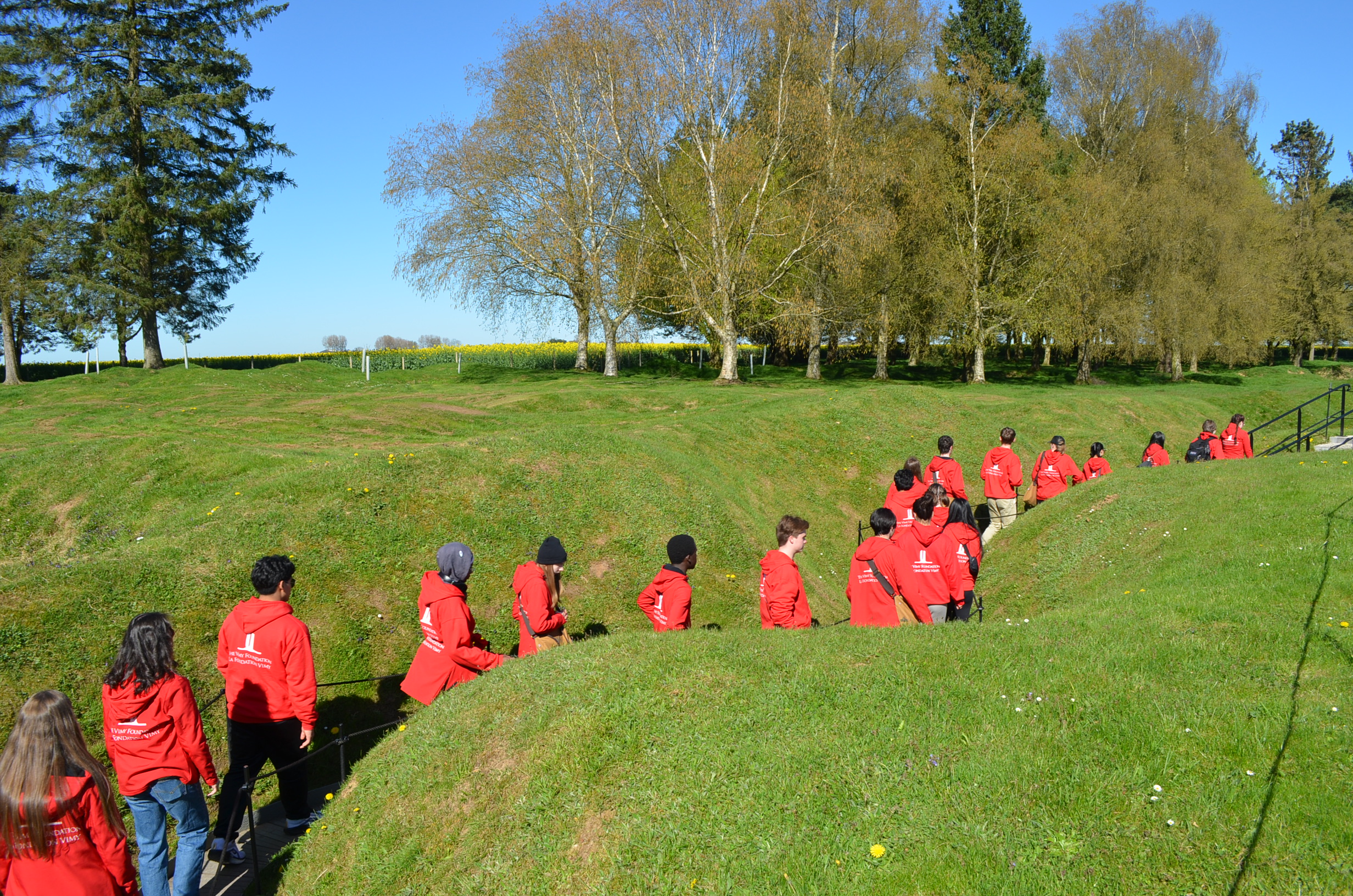
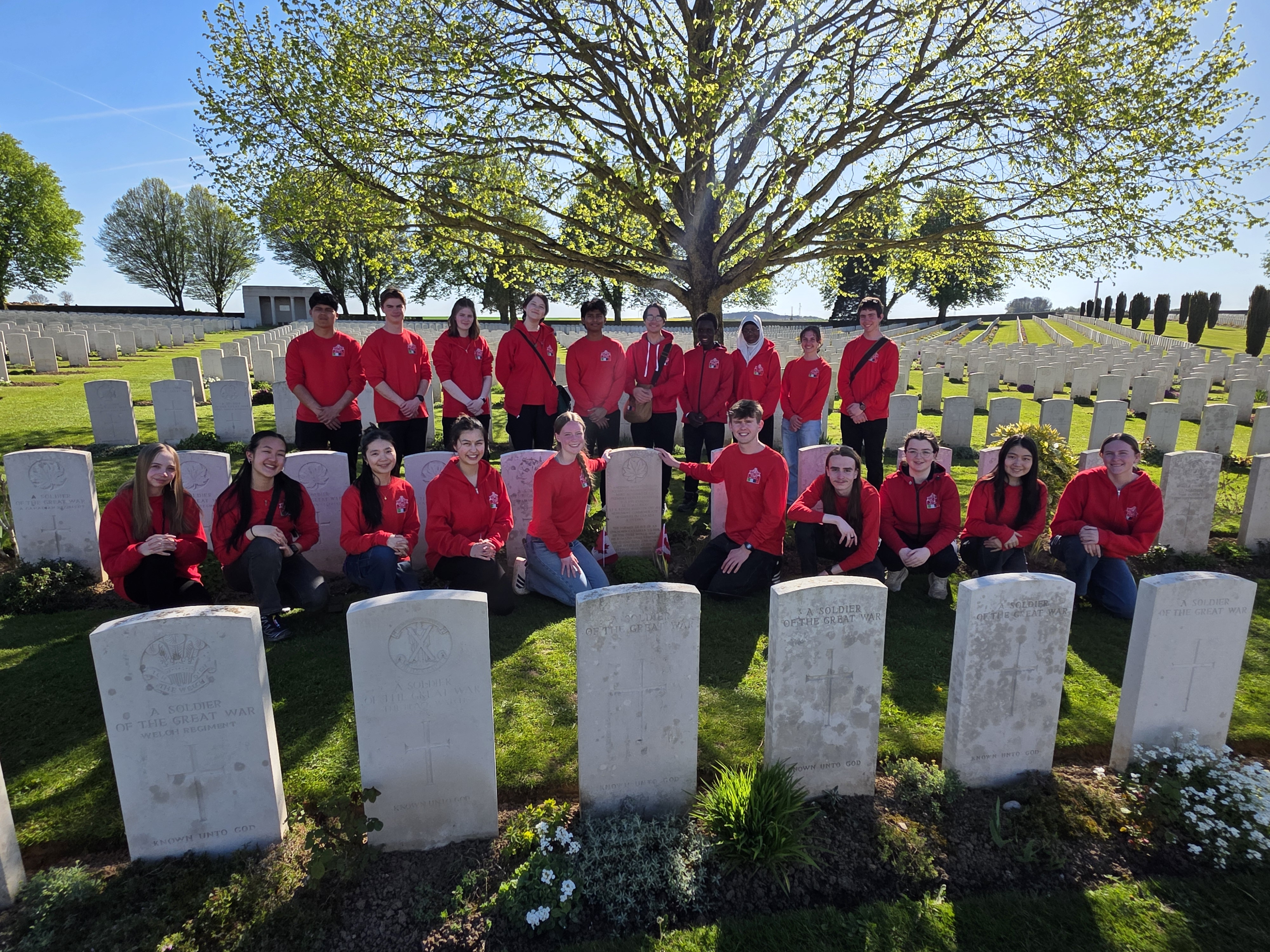
On the 5th day of the Vimy Pilgrimage Award program, the students visited Doullens Citadel, where they took part in a tour and workshop
They then travelled to Bagneux British Cemetery, where Emily presented on Dorothy Baldwin. The group continued on to Wailly Orchard Cemetery, where Elyse delivered her presentation, followed by a visit to the Arras Flying Services Memorial, where Cynthia presented on Robert Jamieson Marion.
In the afternoon, the students visited Notre-Dame-de-Lorette, where they were introduced to the Battles of Artois and their significance in the lead-up to Vimy Ridge.
The group then visited Cabaret-Rouge British Cemetery, where they saw the grave of the Canadian Unknown Soldier and took a group photo.
The day concluded at Écoivres Military Cemetery, where Jackson presented on Roland D’Arcy Strickland.
Today's reflections were shared by Khalid, Mariyah, Cynthia, and Emily.
Khalid
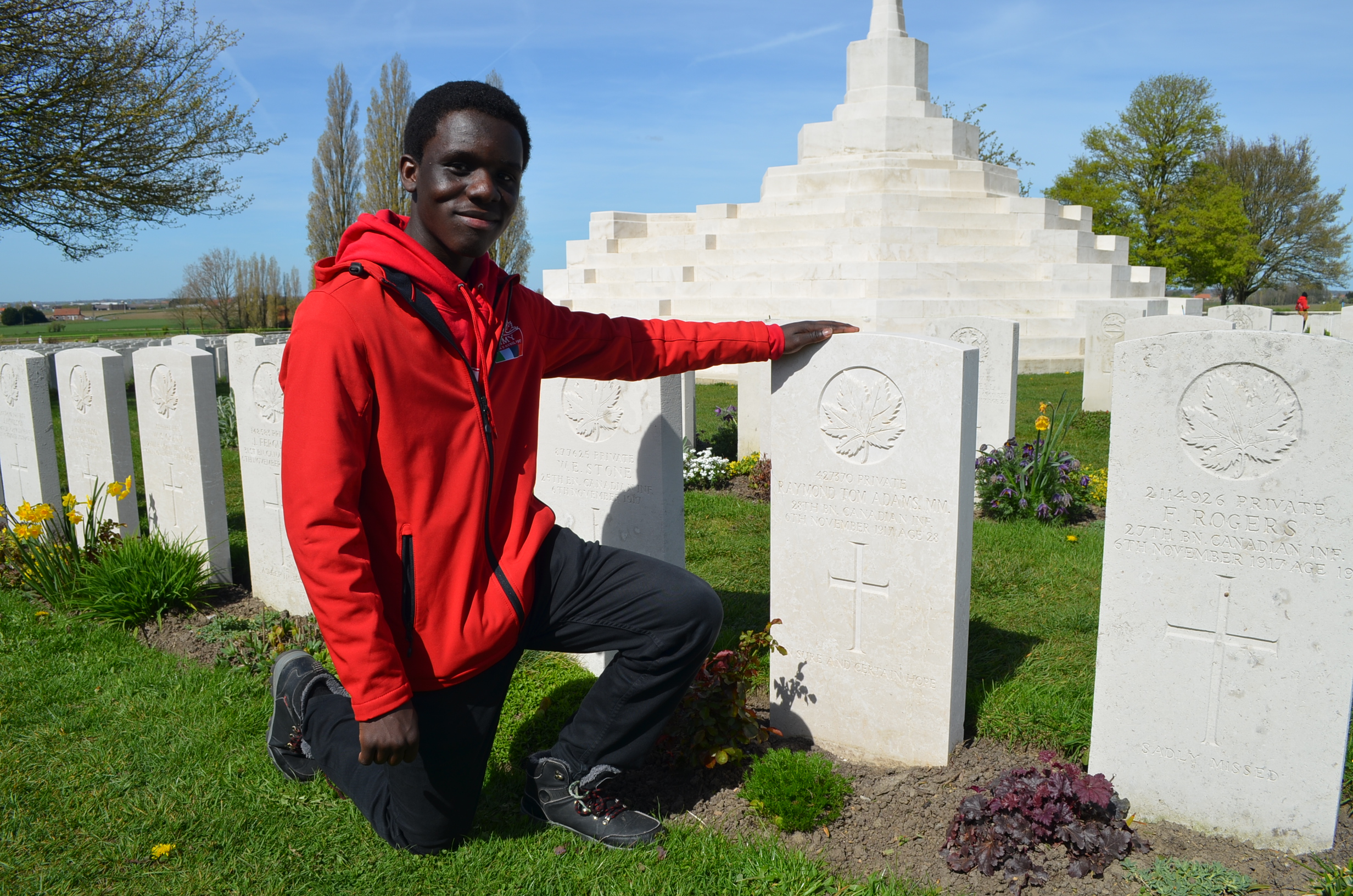
Hello! I am Khalid and I would like to share my experience today with the VPA Program, I am always excited to start every day of this program because I know I will for sure learn something new and see a new perspective of the First World War.
Today what stood out to me by far was the Notre-Dame-de-Lorette cemetery which showed me the absolute horror of war, the graves that stretched unfinished all through the fields, even in the city itself, every turn, every street, it seemed as though there were graves everywhere, to me that just really shows the slaughter that such a war was. The way the French tried integrating religious diversity was quite interesting, it really was a sight to see the different soldiers of different backgrounds all lying in the same equal field in death, in a position that they wouldn’t be in real life at the time. Overall this site, as with all other cemeteries, I can’t just help but be teased into the thoughts of about 110 years ago, the horrors happening on the grounds at which I then stood is now over but the traces are not, teaching me the gratefulness I have for being saved from this and being lucky enough to able to go there for free and come back home and teach and tell others of the dangers of war.
Many soldiers died in this war, and it is always touching when I see my colleagues tell individuals stories, almost bringing them back to life and shining a light on their story that would have been hidden, I can’t help but think that under the ground, the soldiers must be laying there shedding tears of joy, that we chose to cover them, while their millions of uncovered soldiers lay there thinking maybe one day someone may come to visit them and bring them back to life. I very thankful for my peers who also cry and feel some kind of connection to these people who may have not even felt important while they fought this war, placing these people up there.
Thank you for taking the time reading my spiel, I am very appreciative to you for your attention to these heavy topics, I also pass my thanks to the Vimy Foundation for giving me a chance to learn these things, think of these themes and visit the war areas for maybe my only time. Thank you!
Mariyah
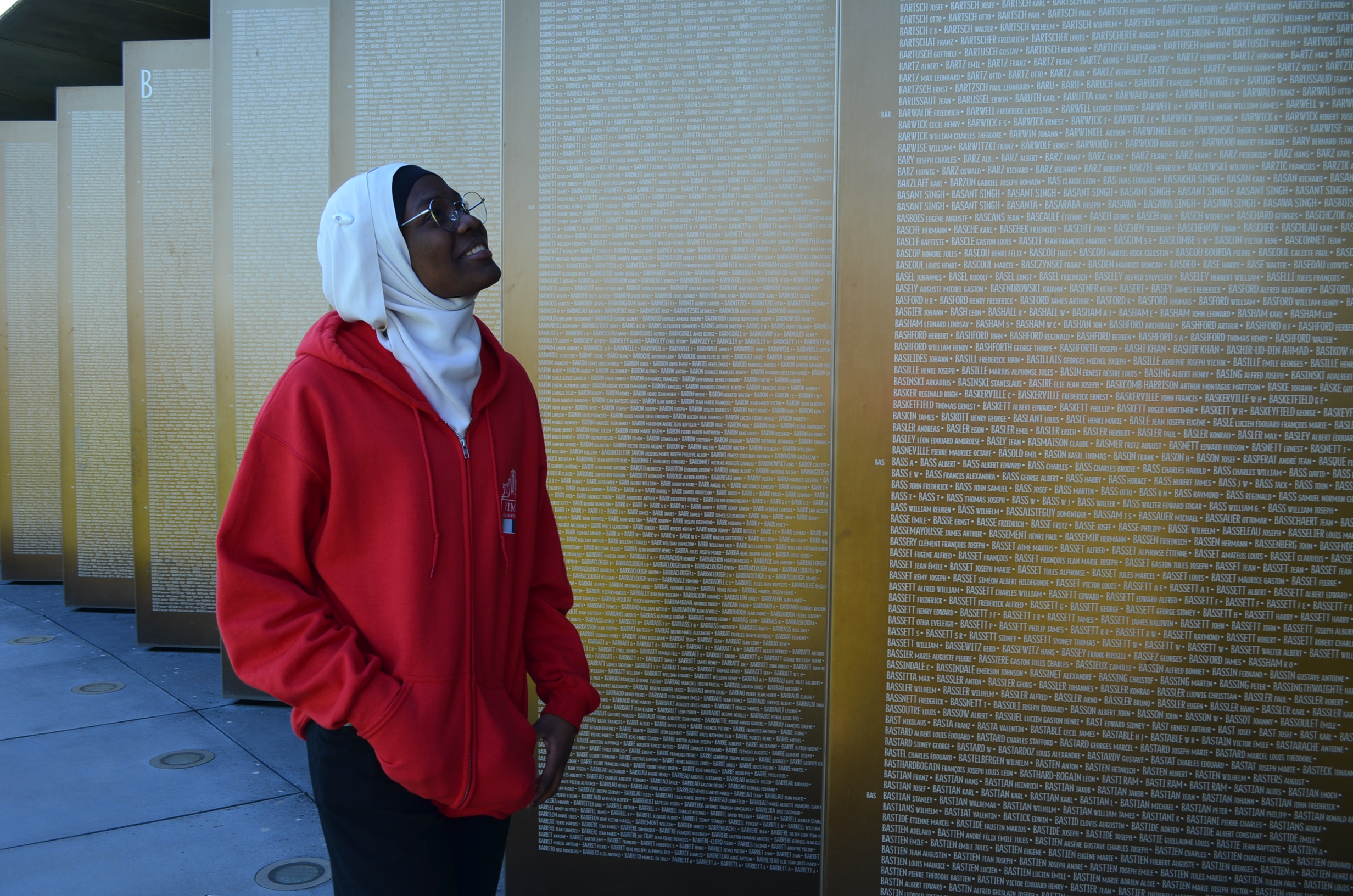
Depuis mon arrivée dans ce programme, chaque jour a été une découverte, mais aussi un voyage intérieur. Lorsque je faisais des présentations devant le groupe, j’ai ressenti une certaine responsabilité. Ce n’étaient plus seulement des informations apprises en classe, mais des histoires réelles que je devais transmettre avec respecte.
Ce qui m’a particulièrement marquée, c’est la différence entre apprendre l’histoire dans les livres et la vivre en vrai. On entend souvent parler de grandes figures, mais être sur les lieux où tout s’est passé change complètement notre perception. Cela rend les choses plus concrètes, mais aussi plus émouvante
Au début, comme beaucoup, j’étais surtout excitée par l’idée de voyager. Mais une fois sur place, voir les tranchées, les monuments remplis de noms de soldats et les champs de bataille de mes propres yeux m’a profondément touchée. Ressentir l’atmosphère de ces lieux marqués par des atrocités m’a fait comprendre que ce n’était plus juste un voyage, mais une réalit
Un des moments les plus marquants a été la visite d’un cimetière où reposaient des soldats de différentes origines. Voir des musulmans, des Noirs et des personnes de cultures variées m’a beaucoup émue. Je me suis dit que cela aurait pu être quelqu’un de ma propre famille. Malgré nos différences, j’ai ressenti un lien très humain, comme si tout s’effaçait face à une réalité commune. J’ai aussi ressenti de la fierté en voyant que des soldats musulmans faisaient partie de cette histoire de la première guerre mondiale.
J’ai également beaucoup apprécié la diversité dans notre groupe. Être quelques francophones dans un groupe majoritairement anglophone crée une belle dynamique. Voir les gens essayer de parler une autre langue et s’ouvrir aux autres est quelque chose que j’ai vraiment aimé. Les accompagnateurs ont aussi rendu cette expérience encore plus positive grâce à leur bienveillance et leur présenc
Ce voyage m’a permis de découvrir des perspectives plus larges de la guerre. Nous n’avons pas seulement appris sur les Canadiens, mais aussi sur les Australiens, les Allemands et les Britanniques, et j'en passe. Cela m’a aidée à comprendre que cette guerre concernait plusieurs nations, même si certaines faisaient face à de la discrimination.
Enfin, la présentation que j’ai faite sur les Premières Nations m’a marquée. J’ai compris que les historiens anciens leur accordaient peu de place, alors que les historiens modernes commencent à mieux reconnaître leur histoire. Cela m’a fait réfléchir à l’importance de raconter toutes les histoire
Cette expérience a changé ma façon de voir l’histoire. Ce n’est plus seulement un ensemble de faits, mais une réalité humaine, remplie d’émotions et de diversité. Je sais que ce que j’ai vécu ici restera avec moi longtemps.
Cynthia
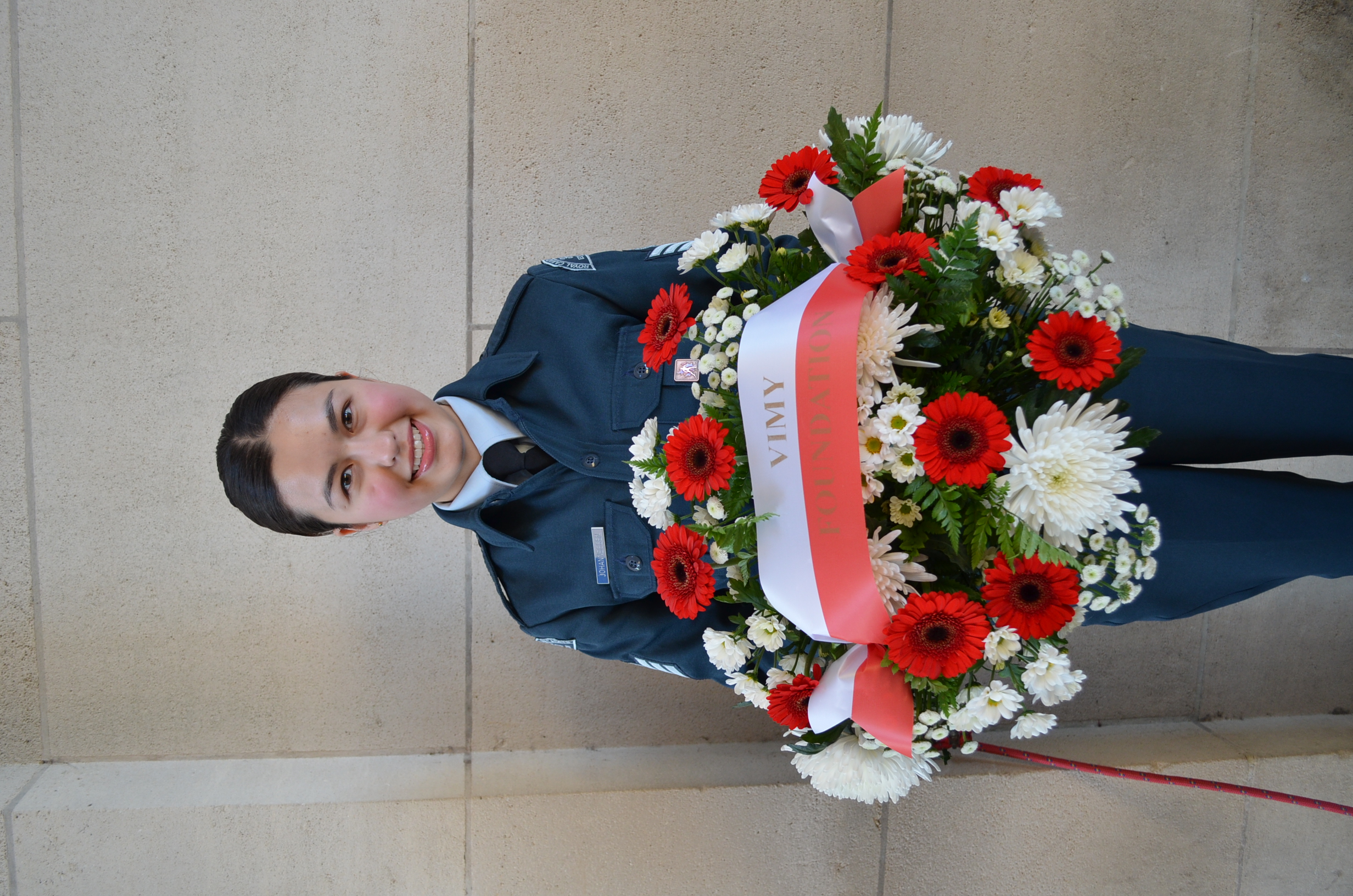
Out of all the days I’ve spent on this incredible program, today especially hit close to home. Today on April 8th 2026, I had the opportunity to share the story of my soldier, Lieutenant Robert Jamieson Marion. Standing at the Arras Flying Service Memorial, in front of his name etched below the Royal Air Force, I felt an overwhelming mix of happiness, sorrow, and remembrance. Never did I expect to feel such a connection to someone whom I have never met. As I presented my biography and letter, I couldn’t help but let my emotions come through. To see the name of someone who I aspire to be, and am so similar to, engraved as a result of death as a pilot, truly made me realize the impact and sacrifice the First World War had on everyday people. Taking a moment to breathe and look around at all the graves and names around me, I reflected that even though I only researched Robert’s story, I was reminded that each name etched into the memorial represents a life just as meaningful, and a story just as impactful. Notre Dame de Lorette was another site that stood out to me. It is the biggest French military cemetery in the world, where 42 000 soldiers are commemorated. Never have I seen a cemetery with an endless amount of crosses buried head to head and in such an organized fashion for rows upon rows. Not only were there only French, but it was interesting to see the Muslim and Jewish headstones who fought proudly on behalf of France. This truly put into perspective the mass amount of deaths that just one country faced and I can’t even imagine how it would look with every death counted. And even then, it was only around 19 000 crosses as the rest were buried in the mass grave. Right beside this national site, was the Ring of Remembrance. What was very meaningful here was the diversity, inclusion, and intricate meaning behind the detail of the design. Its structure is in the shape of a large ring with a gap just below over a nearby town, symbolizing peace, yet reminding citizens that it is a fragile entity. On each panel, states the names of the 576 606 soldiers who died in the Nord-Pas-de-Calais area. At the entrance, we were greeted with the word peace, in multiple languages spoken from across the world. As I saw the word “peace” in my spoken language at home, it evoked a sense of gratitude and pride for my culture. So far, every day has been filled with meaningful adventures and learnings of the First World War and I’m still looking forward to what lies ahead.
Emily
To be very honest, I felt that I was not in the right headspace to write this post. Today was very emotionally challenging as we visited both Doullens Citadel and the Bagneux British Cemetery in which I presented my nursing sister Dorothy Mary Yarwood Baldwin. The Doullens Citadel was both interesting and horrific to visit. On one hand, it was impressive to see the underground tunnels and also to hear about the Canadian No. 3 Stationary Hospital where my nurse served prior to her passing. On the other hand, to learn that it was also home to a prison for young women around my age who have done illegal things of the time like smoking, hit closer to home than I imagined. Not because I’ve done those things but because they would’ve been my age or younger. To hear about the horrific things they endured was very draining. Immediately after the Citadel, we travelled to Bagneux British Cemetery where I presented the life of Dorothy Baldwin as well as reflected on her life in the form of a letter. I expected to feel nothing while reading, and I didn’t while reading my bio, but I did get emotional while reading my letter. Post reading, I did a rubbing of her headstone that I will get to take home with me. There is something so gratifying in having done this experience. In knowing that even in my short reading, I’m still keeping her legacy alive, and ensuring her story is still told. There is also something that I cannot name in knowing I’m repatriating her back to Canada, even if it is just in the form of a headstone rubbing. I’m looking forward to Vimy tomorrow, and all the other sites we will visit in our very short time remaining.
Emily also shared this letter she wrote to Dorothy Baldwin;
Dorothy,
To be quite honest, I wasn’t sure I’d ever be able to relate to you as I believed we lived quite different lives. Now that I’ve reflected more, I now realize there are many similarities between your life and mine. There is something so moving about the way your story continues to resonate, something that feels both distant and strangely close at the same time. As I’m writing this letter to you, I return to the same thought: how remarkable it is that you could achieve so much and leave a lasting impact in such a short lifetime, when so many others live long lives and yet leave behind so little trace of themselves.
I want to be honest with you though. I know that my life cannot compare to yours. You lived in war, a time that demanded a kind of resilience and bravery that is difficult to fully understand from a distance. What you faced and endured exist in a category of experience that stands apart. And yet, in my own way, I find a small thread that connects our worlds.
My mom is a nurse. During the pandemic, she worked on the front lines, and I watched as her life became consumed by the same relentless duty I imagine must have defined your days. She worked long hours, day after day, often with little rest and no certainty about what each new shift would bring. When she did come home, it was not truly a return, she had to isolate, protecting us from the potential risks she could carry. I know this is not the same as war, and I would never claim it to be. But I believe there is a sort of modern parallel in it, a shared thread of sacrifice and of putting aside personal comfort for the sake of something larger. When I think of you on the home front, I imagine the long hours, uncertainty and the quiet strength it takes to keep doing your work anyways.
Through my mother, I have come to understand, even in a small way, what it means to live in the shadow of duty. That is why I think your story feels to real to me. You have reminded me that impact is not always loud, but that it can be built in long hours, and in unseen efforts that are sacrifices that are never fully recognized, but deeply felt by those whose lives are touched by them. Your life was so meaningful, and I come back to it so often. Not because I will follow the same path, but because you show me that it is not the length of time that defines a life but the depth of it.
Your life, though brief, carries weight that continues to ripple outward. It reminds me to pay attention to how I live and the quiet ways in which I can give. I want to say thank you. Thank you for your example and strength. Thank you for the legacy you have left behind. It has reached further than you will ever know.
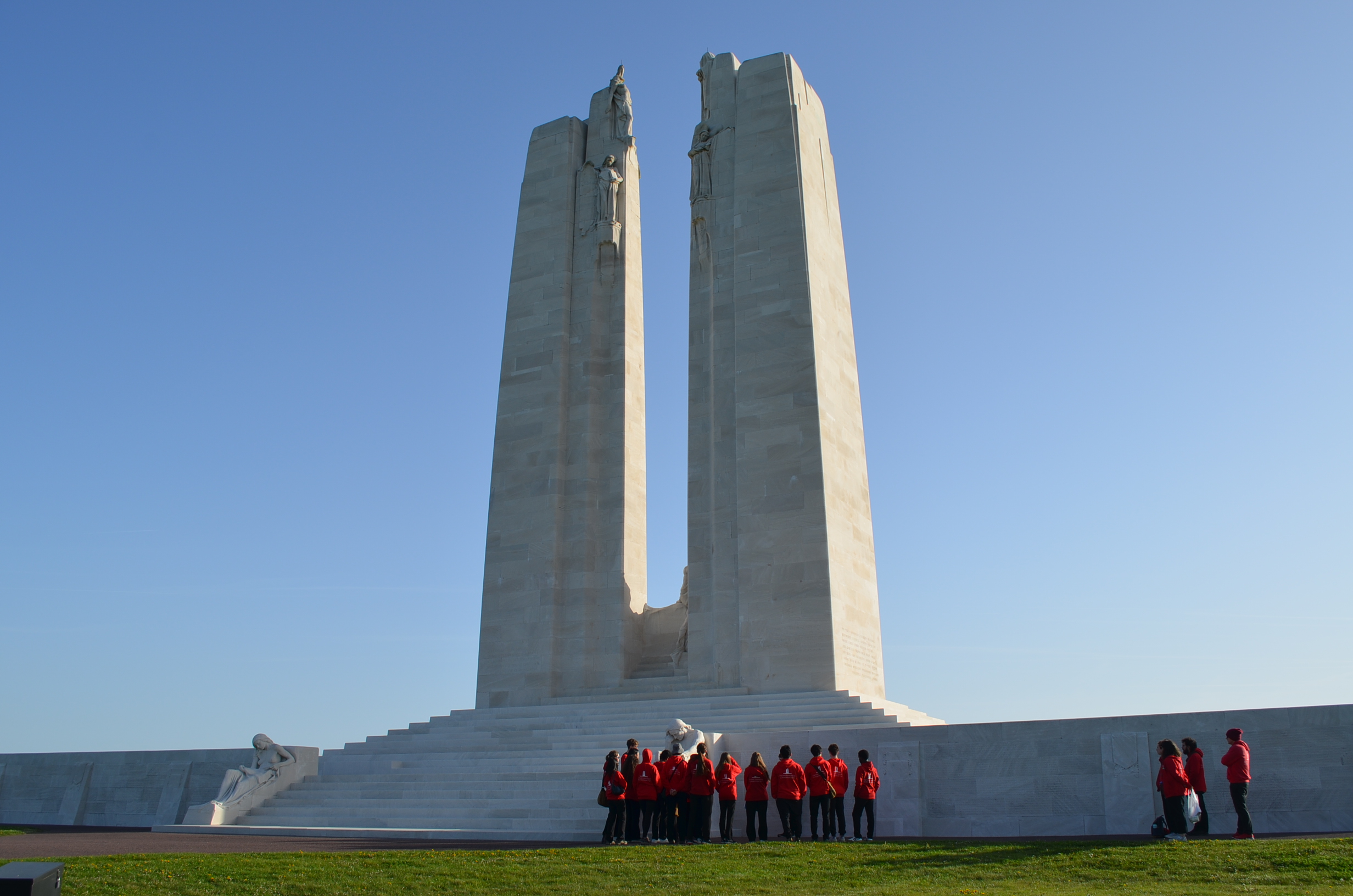
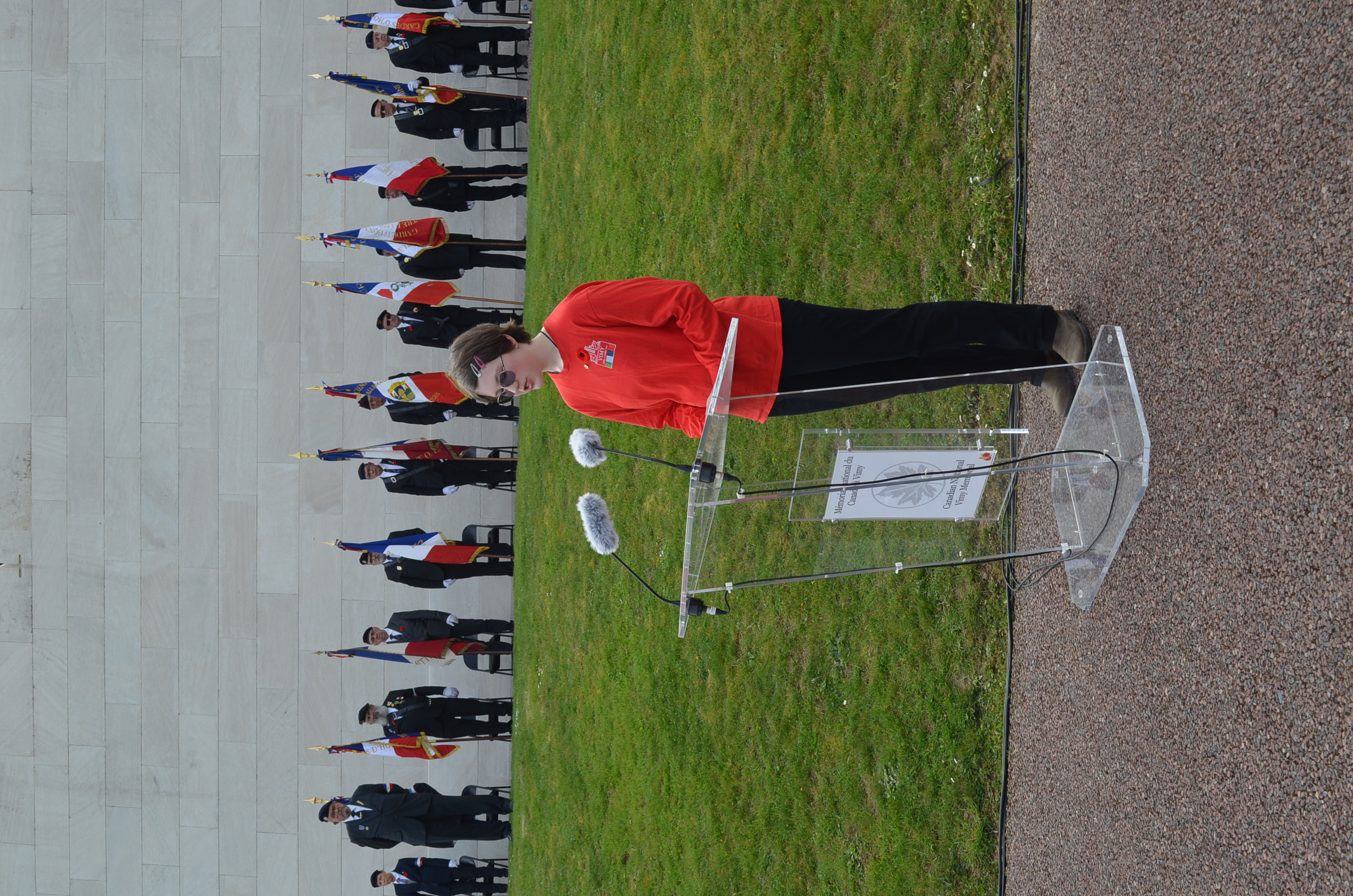
On the 6th day of the Vimy Pilgrimage Award program, students gathered at the Canadian National Vimy Memorial, where they participated in the Vimy Ridge Day ceremony. Edith delivered the Commitment to Remember in French, Abhiraj in English, and Brogan in Inuktitut, while Ella B laid a wreath on behalf of the group, marking a meaningful moment of remembrance.
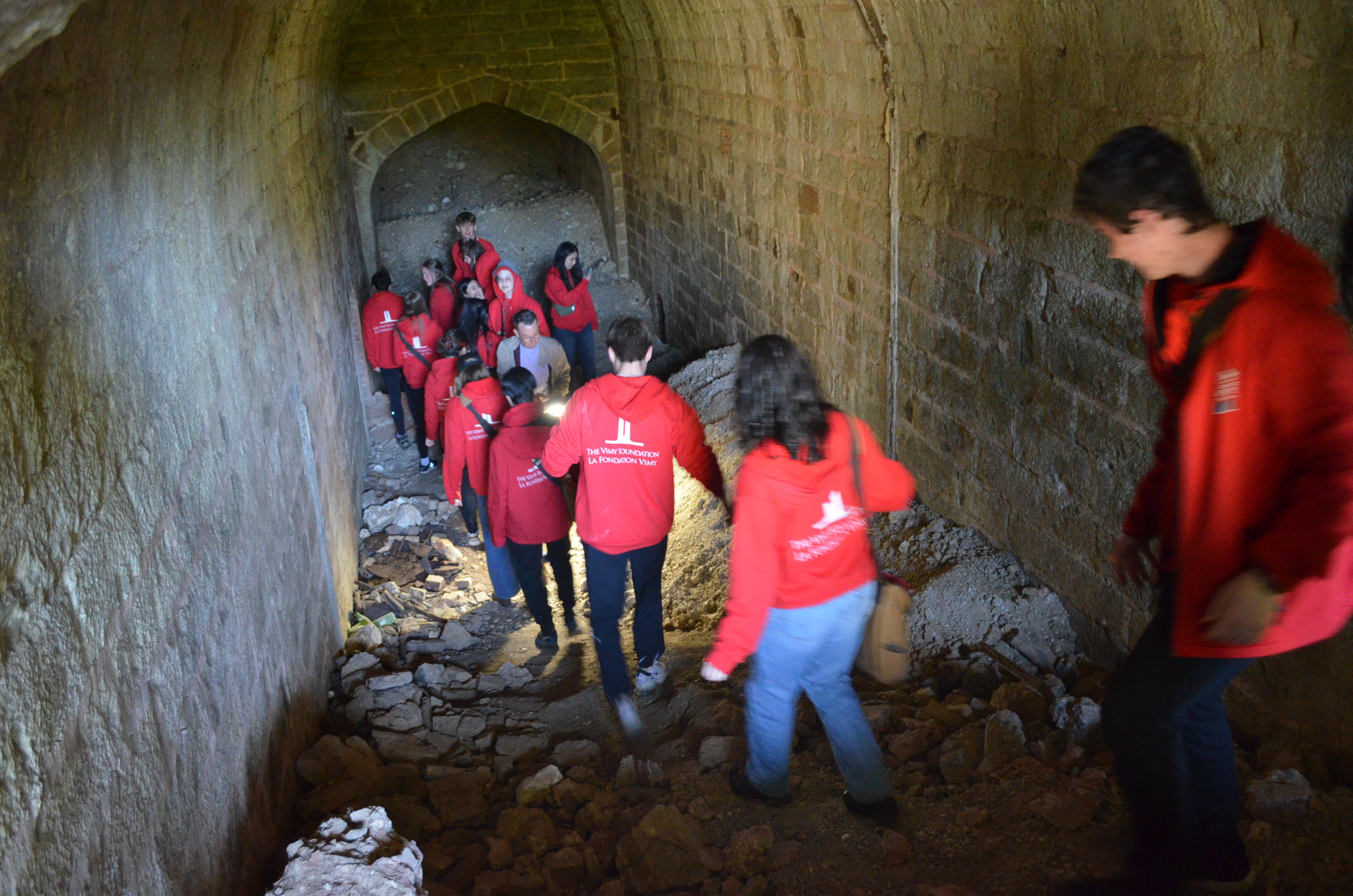
Earlier in the day, students spent time at the memorial reflecting and presenting on individuals commemorated there, before continuing their visits to the tunnels and trenches, Neuville-Saint-Vaast German Military Cemetery, and Cabaret-Rouge British Cemetery. They later visited the Hill 70 Canadian Memorial for additional student presentations.
Today’s student reflections are by Jessy, Jackson, Edith, and Paul.
Jessy
.jpeg)
No photos can truly demonstrate the sheer presence of the columns representing Canada and France. I'm not only talking about their impressive stature, but also the weight of the lost souls that they carry.
Sean mentioned that we should pay attention to the sound of the site, and I'm glad he did. One hundred and nine years ago, the land would have been scarred, barren mud filled with trenches and the blaring sound of gunshots, artillery, and the screams of men. Now, it feels serene. Far too serene. The ground is a luscious green, and all I could hear was the calming chirp of birds and the faint whir of passing cars. The severe contrast brought me great pensiveness. I couldn't help but think, why am I so fortunate to be standing here to be here on an educational program? Countless Canadians, many the same age as me, fought and died here. Why not me?
The ceremony was beyond moving. Before, I simply just knew that our soldiers were killed nearly a century ago for the sake of liberty, and that our victory was unlikely, but our men persevered. Now, I understand. I understand that Vimy Ridge housed so much suffering. I understand that our opposition was not evil, but just doing what they were told, much like our soldiers. I understand that each individual who served here was not just a service number and a gun, but a human who was afraid of not getting to see the sunrise again. This realization occurred not with the sound of guns, but with the sharp melody of bagpipes.
I came on this trip with my Vimy Ridge Monument toonie. I left it on the stone, right in front of the Spirit of Sacrifice. I hope I've done my part to remember the fallen.
Jackson

Today was a really powerful day. We started off visiting the Vimy memorial which to me had the biggest effect on both mentally and emotionally compared to the other memorials that we have visited. Being in the presence of this memorial was extremely powerful in the sense that you can feel the weight and the meaning of it. Being on that ridge brought a new perspective to me. It's as if I was able to picture all the soldiers who fought for not only the same hill I was standing on but for our country. Also, learning about this memorial and the battle that took place on the same ridge over one hundred years ago made me able to appreciate the memorial and to understand more about the importance of strategy during the war.
Furthermore, we also had the opportunity to go into the tunnels used by the Canadians during the war. This made us understand what the actual conditions of not only fighting in the war was like but also what it looked like living underground during the war. We also got a good look at the front line of both the Germans and the allies during the battle of Vimy ridge and it was really interesting to see just how close they were to each other to the point where you could pretty much hear the people in the other trench.
I also had the chance to present my soldier project today which had a bigger emotional effect on me than I thought it would. There was something about presenting and talking about the soldier that you were standing above. It's like you could feel a connection between you and the soldier you were presenting. Especially when I was reading my reflection when I felt that connection that I didn’t quite expect. However I find that this made the presentation way more meaningful.
Another moment that stood out to me was the ceremony at the Vimy memorial. Being able to attend this ceremony was very interesting because it reminded me of the importance of coming together to remember those who have served our country and to see the world connections between two countries. This event made me feel proud to be Canadian and honoured to represent my country at something like this.
Edith
I think that hope is a dandelion. I have not thought this for very long, nor has the thought fully formed in my head to become something I can easily defend, but I will strive to do so today, with you, as I guide you through the events of this third to last day spent in Europe.
We spent most of our day today on Vimy Ridge, where Canada fought one of its key battles as a part of the Allied Forces and managed to seize the ridge, a topographically strategic placement that was previously regarded as unseizable. I very much enjoyed the experience of exploring the tunnels, trenches and the impressive memorial towering over the ridge. It’s definitely very impactful to consider the different circumstances under which soldiers would have viewed this exact same location. While I come in a time of peace, they came in a time of war. While I have the opportunity to discover the beautiful French landscape, they were forced to discover the atrocities of war, gruesome bloodshed, enduring paranoia, mental consequences and all. And while I am able to leave, as I gazed up at the memorial, I was suddenly struck with the brutal reality that none of the soldiers whose names were engraved on that memorial ever made it home.
This same realization buried itself even deeper into my heart when I was given the opportunity to present during the ceremony celebrating the 109th anniversary of the Battle of Vimy Ridge. My speech followed that of important political and military figures, which all celebrated the soldiers that fought in the war. They expressed a sentiment that I feel is prominent when it comes to discussions about war - how these soldiers were brave and honourable, how they were patriotic and driven to fight for Canada. How they never looked back, never hesitated, and trudged on in the mud and rain without fail.
But somehow, despite how high and honourable this image may seem, I feel it does a disservice to the soldiers who fought in the war. Right before the ceremony, one of the chaperones in charge of the trip gave us a briefing about the importance of giving the soldiers their humanity back. Not all, and frankly none of the soldiers were fearless. They all had their doubts, their worries, their dreams for the future. They enlisted to protect their family, or to fight for Canada, or to make money to send back home, or even because they had no choice. We idolize and martyrise these people but I feel as if recognizing their humanity makes their deaths feel even more real, more painful and more tragic.
Thus, when I see a gravestone, now, I do not imagine a soldier so far removed from myself as to become merely a statistic. I see dreamers, artists, carpenters and mathematicians, all of which had their own lives and journeys. As part of our educational journey, we were asked to give presentations on a soldier of our choice, and my presentation occurred today, on Hill 70, where my soldier perished. While Private Frederick Lee was just one soldier amongst many who fought in the war, he meant a lot to me as a Chinese Canadian myself, and taught me so much about the individualism of soldiers, as well as the true meaning of patriotism. Private Lee volunteered as a soldier at a time when racism was rife in Canada, choosing not only to put his life on the line but also to do so for a country which denied him so many rights and freedoms. Despite my best efforts, I can only speculate on his reasons for joining the war, as was the case for all the soldier presentations preceding mine. Through researching him, however, I have come to realize that the war cannot be expressed by statistics alone. Numbers, while effective, give us no clue as to the personality and lives of soldiers, thus barring us from considering them as equals and honouring their sacrifice on an even deeper level.
Our day concluded at the Vimy memorial, where all of the participants awarded medals to the person sitting to their right, expressing their emotions in regard to the trip before doing so. As the sun went down on Vimy, we sat around a dandelion which had been half blown by the wind, telling stories, laughing, and crying as we sat on the same ground where soldiers once walked, felt the same cool air that must have froze them to the bone on cold winter nights. And I thought about the dandelion, accidentally present right at the center. I thought about how they are present everywhere, how they are an invasive species that most hate but that never die. Hope can feel dangerous sometimes. It probably did to the soldiers in the war, almost like a delusion, something to repress and to ignore. It feels dangerous to hope for peace still, today, to believe that tomorrow will be a better day. But I am writing to ask you all to try. Dandelions are invasive only because they have such an excellent ability to reproduce, just as the memories of the First World War are passed down to us all. The seeds of remembrance, the seeds of dreams, the seeds of wishes whispered below the setting sun, are ours to carry. That burden is the biggest honour of them all.
Paul
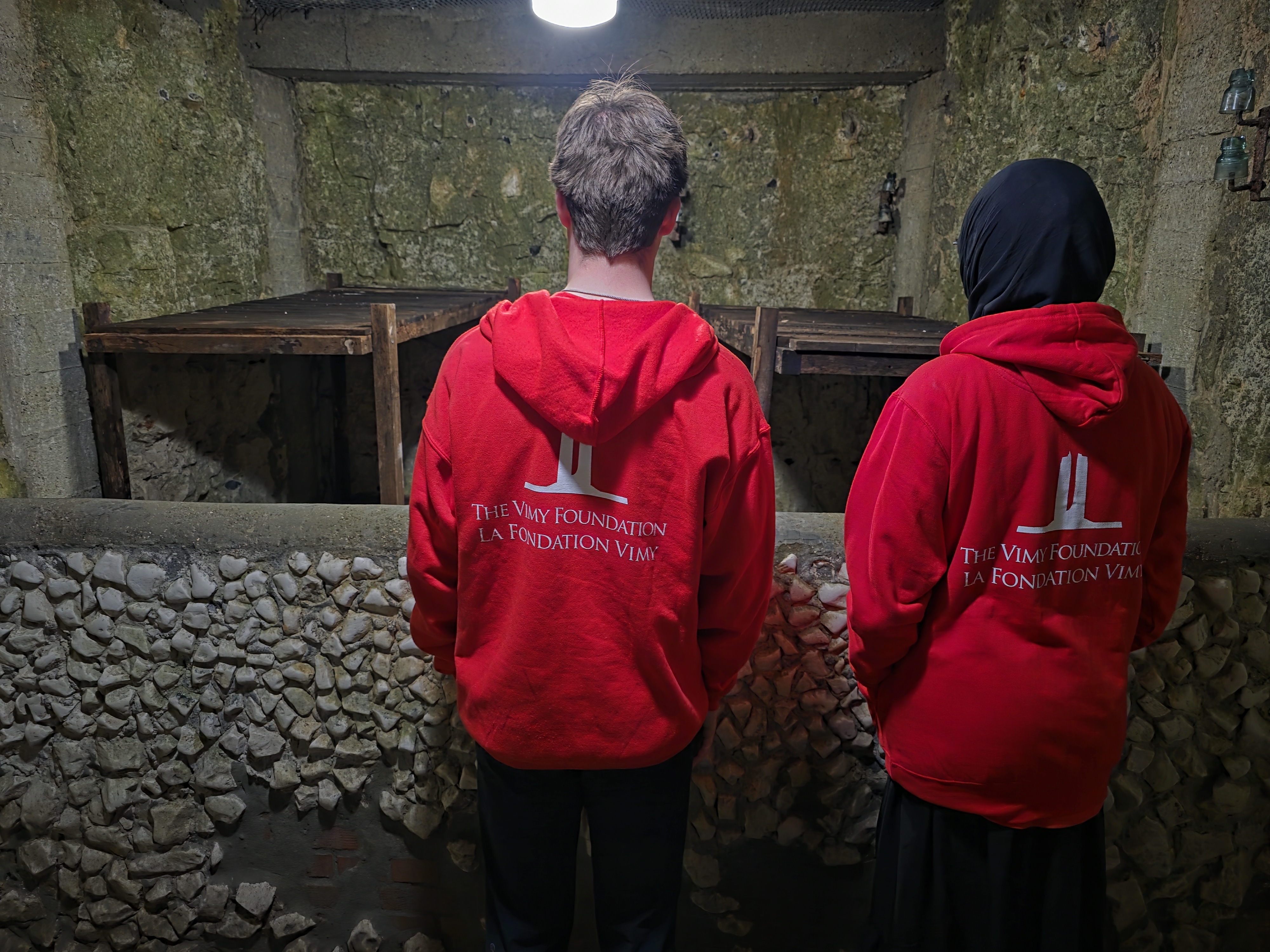
Yesterday was our second last day of the Vimy Pilgrimage Award program in France and Belgium, and it ended up being one of the most meaningful days of the entire trip. The highlight of the day was visiting the Vimy Ridge Memorial near Arras, France, but what made the experience even more powerful was also visiting the tunnels carved by the French and later used by the Canadians as they prepared for the assault on Vimy Ridge. I had learned about Vimy before, but being there in person was completely different from reading about it in class. Walking through those tunnels made the history feel much more real and immediate. It made me think about the soldiers waiting underground, knowing what they were about to face, and the fear, courage, and uncertainty they must have carried with them. Standing in that space made the history feel personal in a way I did not expect because it connected me to the human side of the battle, not just the military facts. When I was younger and fascinated by the First World War, I mostly saw history through numbers. I would hear things like 11,000 deaths, and while that sounded huge, it still felt distant in a way. Visiting the cemeteries throughout this trip completely changed that perspective for me. Instead of seeing the war only through statistics, I began to see it through individual names, ages, and lives that were cut short. It changed the way I understand loss and sacrifice entirely. What once felt like numbers on a page now feels deeply human, and that shift in perspective is something I will carry with me long after this program ends. Another part of the day that stayed with me was learning about queer soldiers during the First World War. I found that especially interesting because it showed a side of history that is not always spoken about enough. It reminded me that history is much more than battles, victories, and names written in textbooks or carved into stone. It is also about real people, their identities, their struggles, and the stories that were often overlooked for many years. Learning about that added another level of meaning to the day and made me reflect on how important it is to remember everyone who served, not only the people whose stories are most commonly told. At the end of the day, we returned to the Vimy Memorial for a group circle where we presented the Vimy Pilgrimage Award medal to one another. As we did that, each of us shared why we had applied to the program. I explained that my cadet corps commanding officer had encouraged me to apply, and I am grateful that he did. When I first joined this program, I expected it to be a valuable learning experience about Canada's role in the First World War, and it absolutely has been. What I did not expect was how much the people in this group would shape the experience for me. Meeting all of these wonderful people has made the program even more meaningful than I imagined. Every person here is different, but each of them brings something special to the group. Getting to know them, learning alongside them, and hearing their perspectives has helped me understand this program on a deeper level. It is not only about remembering the sacrifice of Canadians in the First World War, but also about carrying those stories forward and sharing them with our peers, our cadets, our teachers, and anyone willing to listen.
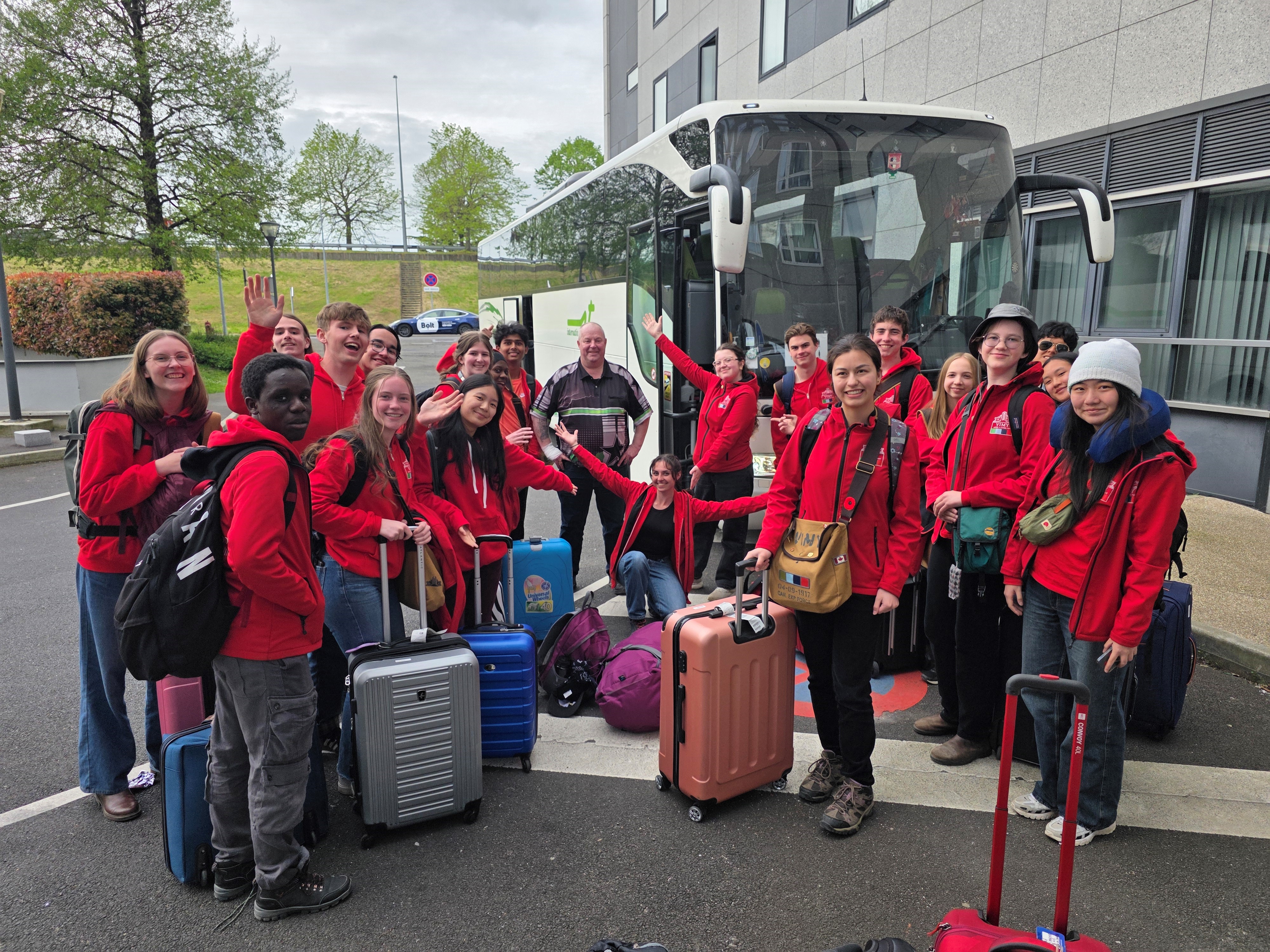
On the 7th and final day of the Vimy Pilgrimage Award program, students continued their journey of remembrance with visits to Wancourt British Cemetery, where Mariyah presented on Henry Norwest, and Cagnicourt British Cemetery.
They then travelled to Somme American Cemetery, where students were introduced to the site and engaged in meaningful discussions.
The day concluded at Clairière de l’Armistice, the historic site where the Armistice was signed in 1918, marking the end of the First World War.
As the program comes to a close, students prepare to return home to Canada, carrying with them the stories, reflections, and connections they have made throughout their time in France and Belgium. To mark this final day, students were also asked to choose a colour that best represents their experience and explain why, here is what they said:
Amelia: Red like the blood spilled by the soldiers over 100 years ago, but also red like the Vimy Pilgrimage Award Clothing that brings us all together – red like life and death.
Joseph: Grass green because off how the grass and foliage replaced the death and suffering of the war, and how life is slowly healing the landscape around us.
Jackson: I chose the colour of sunset orange for the sunrise and sunset that sets the start and the end of each new day to learn and remember.
Khalid: Sky bright blue because throughout this program it has been bright and the sun is shining like never before. The blue sky signifies a rebirth and life to a place that felt as though it was a void of life; war. In April 1916, it was dead and dark, in April 2026 it is light and alive.
Sophie: I chose coffee brown, the color of the earth, the color of the coffee I had this morning but also the mud that took the lives of many. What is given to us as a way to create life also took lives on the warfront.
Danielle: Jade green because it is in the middle of the rainbow which represents how all the participants are unique and on different spectrums of the rainbow, however we have all met in the middle to educate ourselves and honour others through the process of this program.
Cynthia: Bright orange to represent the eye-opening and transformative “wow” feeling of this program. I can’t even begin to explain it but throughout our visits to cemeteries and memorils, I feel as though l have discovered a completely new world of appreciation. It’s like a new sun in my world.
Connor: The green of the grass and the trees: “We love thee, smiling land”.
Ella C: Someone very dear to me that I lost meant orange to me. I see that same orange light in those around me on this program. However, I am choosing ethereal aqua because I acknowledge the difference amongst others with the sharing of the same hope and kindness. I hope to be shaped by their stories and choose to make a positive impact of those around me, just as the memories of those soldiers have.
Edith: I chose grey because it is the colours of the soldiers’ graves, all carved from the same time of stone and therefore all equal. It is also the color of justice and solemnity. This reminds me of the importance of equality in memory.
Brogan: Chestnut brown because it is the colour of the soil and mud that the soldiers fought on and where many died. The colour of the trenches and no man’s land – the blood-soaked soil of Europe that has now grown new life.
Mia: The soft moss green of the rolling hills lie; they tell not of the battles they have seen; only remain to serve as reminders to those who remember.
Emily: I chose light blue to represent the tears both in response to topics on soldier/nurse presentations throughout the program.
Paul : Crop green because of green rich fields now grow from the blood of the fallen.
Jessy: Though I feel an intense heaviness when I walk into a monument or cemetery - it is lightened by the joy of what I’m learning and the people around me and therefore the only colour I could choose was light blue.
Ella B: Bright, sunny yellow like the dandelions that emerge from the scared land – home to battles of the past.
Elyse: Le sang versé par les soldats pour leur patrie est le même que celui qui traverse nos veines encore à ce jour. Ils sont humain tout autant que nous.
Mariyah: J’ai choisir la couleur violet pour la lavande. La lavande est une fleur avec une bonne “sentuer” et belle structure, comme les monuments qui sont biens structurer.
Abhiraj: Forest green because it has shaped my values and ethos. To represent this nature, and this colour of life and creation – this is why I chose this colour.
Jasmine: A warm sunlight yellow – This yellow reminds me of the warmth on my skin during the program. A specific moment I thought was the sun beaming from the East over the arches and names of the Thiepval Memorial. The sun was on part the wall; and made me think of hope and also memory.
Check out our products in our boutique
View All Products


$ 300.00
$ 300.00
.png)
$ 300.00
$ 300.00

.png)